
For three weeks here in Montreal it was Department time at SSP14. Participants chose from either Space Sciences, Policy, Economics & Law, Space Engineering, Space Applications and my Department Human Performance in Space. During these few weeks they attended the Departmental Activities that have been planned for the past few months.
My Department Activities included a variety of professional visits, visiting lecturers and workshops that enriched the lecture material given at the start of the program. As the Teaching Associate for Human Performance in Space, I had the chance to work alongside some fantastic visiting lecturers and participants!
 The first Departmental Activity was a Neuroscience Workshop. Participants used neuroscience equipment flown onboard the Shuttle that was utilised for measuring disturbances in spatial orientation (posture, eye moments, cognition) - typical in astronauts after returning to Earth. It was pretty fun to watch everyone try to write their names whilst wearing inverted mirrored goggles :)
The first Departmental Activity was a Neuroscience Workshop. Participants used neuroscience equipment flown onboard the Shuttle that was utilised for measuring disturbances in spatial orientation (posture, eye moments, cognition) - typical in astronauts after returning to Earth. It was pretty fun to watch everyone try to write their names whilst wearing inverted mirrored goggles :)

HPS also visited the PERFORM Centre - a research-driven facility with state-of-the-art equipment and ultra-modern laboratories and suites. We were able to see experiments take place in the Functional Assessment Lab and Cardiopulmonary Suite.


Last year's TA for HPS, Ana Diaz visited the Department and gave an interesting workshop on Spacesuit Design.

She brought along some sample spacesuits from Massachusetts Institute of Technology (MIT) - including the famous Biosuit which I'm posing with below.


The nearby Cosmodome in Laval provided hours of fun. The space centre has three different virtual missions that include challenges such as testing piloting abilities and collaborating with crew members to construct the International Space Station (ISS).
Last year's TA for HPS, Ana Diaz visited the Department and gave an interesting workshop on Spacesuit Design.
She brought along some sample spacesuits from Massachusetts Institute of Technology (MIT) - including the famous Biosuit which I'm posing with below.
The nearby Cosmodome in Laval provided hours of fun. The space centre has three different virtual missions that include challenges such as testing piloting abilities and collaborating with crew members to construct the International Space Station (ISS).


As the Human Performance in Space Department, we had some astronauts visit us including Canadian Space Agency (CSA) astronauts Bob Thirsk, David Saint-Jacques and the first Korean astronaut Soyeon-Yi. This in turn led to a astronaut selfie with my friend Hugo - an opportunity too good to miss at space school :)


Bob Thirsk and David Saint-Jacques ran a workshop on Space Scenarios that I devised with help from Bob. Participants spent time imagining themselves in different real-life space situations such as a hard-working yet isolating crew member or a trajectory occurring back on Earth and we discussed potential outcomes of these. It was interesting to put ourselves in the shoes of an astronaut orbiting above the Earth.
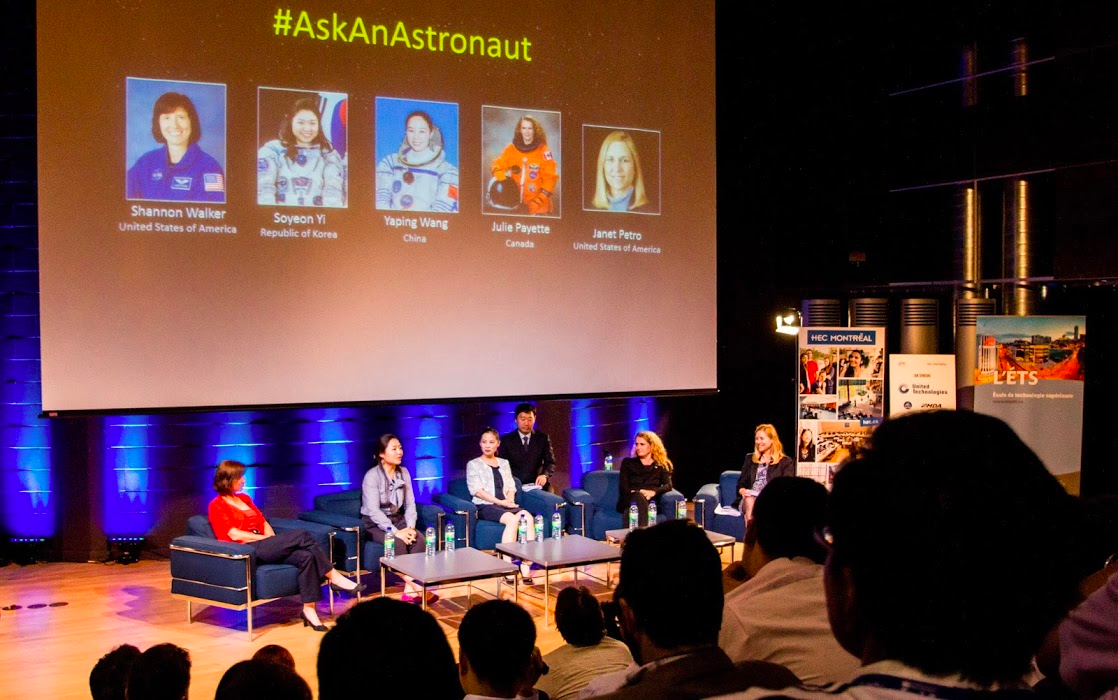
Soyeon-Yi took part in the annual Space Studies Program astronaut panel the night before. This was the first year that the panel was all-female! One small step for women and one giant step for gender equality :)

The last week of Departmental Activities included a visit to the Canadian Space Agency (CSA) and the Montreal Biodome.
As the Human Performance in Space Department, we had some astronauts visit us including Canadian Space Agency (CSA) astronauts Bob Thirsk, David Saint-Jacques and the first Korean astronaut Soyeon-Yi. This in turn led to a astronaut selfie with my friend Hugo - an opportunity too good to miss at space school :)
Bob Thirsk and David Saint-Jacques ran a workshop on Space Scenarios that I devised with help from Bob. Participants spent time imagining themselves in different real-life space situations such as a hard-working yet isolating crew member or a trajectory occurring back on Earth and we discussed potential outcomes of these. It was interesting to put ourselves in the shoes of an astronaut orbiting above the Earth.
Soyeon-Yi took part in the annual Space Studies Program astronaut panel the night before. This was the first year that the panel was all-female! One small step for women and one giant step for gender equality :)
The last week of Departmental Activities included a visit to the Canadian Space Agency (CSA) and the Montreal Biodome.

We visited the headquarters of CSA and saw the Canadarm training facilities as well as observing mission deployment using a Juno rover prototype in the outdoor Mars yard. The rover was controlled via remote tele-operation from the ExDOC control centre.


 The penultimate Departmental Activity took us to the Biodome - the 'house of life' in the heart of the city. Its 5 enclosed ecosystems are a great way to learn about life support systems in space. Animals and plants from across the world are housed here including the adorable sloths and penguins (my favourites)!


 The last Departmental Activity was Project Presentation Day. Participants in my Department had been working on a Human Performance in Space project for the past 2 weeks. With topics ranging from embryonic development in space to the influence of plants on humans in space, the talks were very insightful and I loved hearing such interesting presentations from everyone. Below is a presentation on a project that I proposed - Creative Communication of HPS. I was very impressed with the inspiring results of the research done by Ariane and Akane - the wonderful participants that chose my topic :)
 Afterwards, we treated everyone to a surprise party complete with balloons, cake and snacks! Always a great combination. As a thank you for my work as their TA, the participants got me a cute teddy and flowers :) I miss my HPS-ers already!


 Following the end of Department time, Alumni Weekend was upon us here at SSP14. Every summer, International Space University alumni from across the globe attend this weekend wherever that year's summer program is taking place. Below is a photo of alumni from the year that I did SSP in Florida - SSP12 :)

The annual Space Masquerade Ball and Alumni Vs Participant football match also takes place during Alumni weekend. There's a costume competition and this year's prize went to a group that collectively dressed up as the International Space Station! Cultural night was also incredible this weekend since it was Canada's turn - they put on a great show!

Right now we're in the middle of Team Project work. It's pretty hectic with report writing, editing and deadlines but the end of SSP will be upon us next week as Week 9 arrives and we will start to fly back to our respective corners of the world. SSP has once again ended too soon -my next blog post will include some of the highlights of SSP14 so that I can relive the program through memories of the summer.
We visited the headquarters of CSA and saw the Canadarm training facilities as well as observing mission deployment using a Juno rover prototype in the outdoor Mars yard. The rover was controlled via remote tele-operation from the ExDOC control centre.
The penultimate Departmental Activity took us to the Biodome - the 'house of life' in the heart of the city. Its 5 enclosed ecosystems are a great way to learn about life support systems in space. Animals and plants from across the world are housed here including the adorable sloths and penguins (my favourites)!
The last Departmental Activity was Project Presentation Day. Participants in my Department had been working on a Human Performance in Space project for the past 2 weeks. With topics ranging from embryonic development in space to the influence of plants on humans in space, the talks were very insightful and I loved hearing such interesting presentations from everyone. Below is a presentation on a project that I proposed - Creative Communication of HPS. I was very impressed with the inspiring results of the research done by Ariane and Akane - the wonderful participants that chose my topic :)
Afterwards, we treated everyone to a surprise party complete with balloons, cake and snacks! Always a great combination. As a thank you for my work as their TA, the participants got me a cute teddy and flowers :) I miss my HPS-ers already!
Following the end of Department time, Alumni Weekend was upon us here at SSP14. Every summer, International Space University alumni from across the globe attend this weekend wherever that year's summer program is taking place. Below is a photo of alumni from the year that I did SSP in Florida - SSP12 :)
The annual Space Masquerade Ball and Alumni Vs Participant football match also takes place during Alumni weekend. There's a costume competition and this year's prize went to a group that collectively dressed up as the International Space Station! Cultural night was also incredible this weekend since it was Canada's turn - they put on a great show!
Right now we're in the middle of Team Project work. It's pretty hectic with report writing, editing and deadlines but the end of SSP will be upon us next week as Week 9 arrives and we will start to fly back to our respective corners of the world. SSP has once again ended too soon -my next blog post will include some of the highlights of SSP14 so that I can relive the program through memories of the summer.


