Showing posts with label science communication. Show all posts

Wednesday, 10 December 2014

The Space Generation Advisory Council


You may have seen my blog post on the Space Generation Congress (SGC) back in October in Toronto this year. Organised by the Space Generation Advisory Council (SGAC), it's the place to be if you're a student or young professional interested in the key issues in space of this generation. 


I am happy to say that I have recently been selected as one of the organisation's Copy Editors. Joined by 5 other peers, we will work alongside the existing Copy Editors to shape the documents and papers presented around the world on behalf of space professionals and students. 


Comprised of volunteer students and young professionals in the space industry from over 100 countries across the globe, SGAC is the voice of the space generation of today - the space sector leaders of tomorrow. The network connects us to leaders in the United Nations (UN), space agencies and academia. Working in conjunction with the United Nations Committee  on the Peaceful Uses of Outer Space (UN COPOUS), SGAC has the power to communicate ideas across disciplines, generations and oceans. 

I'm very happy to join the SGAC team and help to shape the innovative work that is being done here.


-Nikita

Wednesday, 3 December 2014

I Love to Sail Forbidden Seas


This famous quote by Herman Melville in Moby Dick is featured in this recently released short film named 'Wanderers'. Narrated by the legend that is Carl Sagan, the magical film by Erik Wernquist is a window into the future of humanity as we evolve into the space-faring species we are destined to one day become. It is inspiring, stunning and most of all makes me think I was born a century too early!


-Nikita


Friday, 24 October 2014

Disaster Playground: The Edge of Space Fiction with Nelly Ben Hayoun


You might have heard of French director and designer of experiences Nelly Ben Hayoun from her past creative concoctions such as the International Space Orchestra and her musical collaboration in space with Beck and Bobby Womack. Designing immersive experiences is her forté and her latest creation, Disaster Playground, is no exception. This creative platform explores the theme of catastrophic asteroid collision – both in real-life and Hollywood movies – dancing on the edge between space and fiction through an immersive exhibit and a feature film. Disaster Playground questions the notion of disaster and investigates the human response and cross-cultural reactions to the threat of potentially hazardous asteroids. I recently spoke to Nelly about this exciting new project.
“I am looking at designing ‘extreme experiences’ for the public in order for them to question what the future of space exploration might be, how could they make dark energy in their kitchen sink, and other surreal experiences,” explains Ben Hayoun. She also incorporates real-life space scientists and thinkers in her work. “Disaster Playground is a critical platform that engages the main actors of the project to reflect on their practice and get members of the public to engage with what the craft of space exploration is, who are the people ‘making’ it, and where is this all going?”
Dr. Peter Jenniskens, meteor showers specialist at the SETI Institute, and Director Nelly Ben Hayoun
Director Nelly Ben Hayoun (center) with Dr. Peter Jenniskens, meteor showers specialist at the SETI Institute, during disaster communication training at Disaster City, TEEX, Texas (Credits: Nelly Ben Hayoun/Nick Ballon).

The Real Armageddon

Disaster Playground: The Feature Documentary is about the scientists monitoring and planning the deflection of hazardous near Earth objects (NEO). It addresses the complex decision-making process of protecting the Earth from NEO impacts and the associated challenges. The plotline of the film follows the progress of NASA’s actual asteroid impact procedure. It depicts the chain of command required when there are only a few experts who understand the technology needed to tackle the threat of an asteroid collision with Earth.
“It is about the design of emergency procedures, nailing down who is in charge, who defines the procedures when things go wrong, and according to which rationale,” explains Ben Hayoun.
Ben Hayoun was inspired to create this film in response to pop culture views of space disaster such as the portrayal in the blockbuster Armageddon. In the film, Hollywood relied on Bruce Willis and a giant drill to save the world. How realistic is this and what is really needed to save our civilization from the next major asteroid impact? This is where Disaster Playground picks up the story, in what Ben Hayoun has dubbed space fiction.
“We are looking at the pop culture as a start and then we engage with the reality of each event, the real people who are the real Bruce Willis – thus the term space fiction,” she says. “The film aims to get you to engage critically with the human condition in place in the space program, the craft, the real people doing it, their quirkiness, their sometimes imperfect reactions, and their successes.”
Cowboy on red phone from Disaster Playground
Who ARE the people on the other end of the “red phone” when disaster strikes? In Disaster Playground, we find out (Credits: Nelly Ben Hayoun/Nick Ballon).

The Stars of the Show

World-renowned space experts from NASA and the SETI Institute, as well as an all star team of composers, writers, and international collaborators, joined forces on this project. Names such as Dr. David Morrison, Director of the Carl Sagan Center and the SETI Institute; Dr. S. Pete Worden, Director of NASA Ames Research Center; Dr. Jacob Cohen, Chief Scientist at NASA Ames Research Center; and Dr. Jill Tarter, outgoing Director of the SETI Institute all reenact moments of discovery and key events from their research.
“Each of these scientists has a role in some form or shape with the chain of commands or the development of emergency responses…they informed the film and perform their role in the film,” says Ben Hayoun. “Basically, Disaster Playground is their film but it is directed to us. It is about sharing the experience of dealing with such decisions as: ‘Shall we send that asteroid there or there? Where shall we move it?’”
The Theater of Cruelty
Ben Hayoun has been called the “Willy Wonka of design and science” and her bold design practice has gathered the attention of many – including WIRED magazine, which awarded her its 2014 Innovation Fellowship. She carefully crafts creative modes of communication to explore the depths of design using the theme of space. She takes inspiration from French philosopher and socialist Jean Baudrillard and his text America, as well as dramaturges such as Antonin Artaud who introduced the concept of the Theater of Cruelty.
Ben Hayoun wanted to explore the moral ambiguity of using catastrophe to spark interest in space. The explosion of the Space Shuttle Challenger, for instance, created an iconic image. That billowing stream of smoke and flame symbolized a horrific loss of life and severe misstep in the US space program, but it also reignited public interest in that program.
“Our interest for such mortal catastrophe can be identified as a perverse human curiosity,” notes Ben Hayoun. “We believe that this perversity captures one crucial element of what the viewer wishes to see: how technology and humans can beautifully ‘fail’ and, in turn, cause us to reflect on the making behind our discoveries.” She uses just that phenomenon in her work, exploring the situations created when existential danger threatens. “I believe that, by taking an extreme approach, you really get the audience to actively engage with a cause or an area of research and that is what motivates me when it comes to space exploration.” Ben Hayoun hopes that engaging the public will lead to increased support for space. “I want to see the next woman on Mars or on an asteroid, and without public backing that will not happen.”
Disaster City training on asteroid impact response
Disaster City training on asteroid impact response (Credits: Nelly ben Hayoun/Nick Ballon).

The Disaster Playground Media

The theatre in which Disaster Playground is exhibited blends the various media forms the project assumes: documentary feature film, book, and exhibition. A visitor walking into the exhibit experiences live reenactments, journeys through landscapes, and interacts with props ranging from model spacecraft to live goldfish. “Each of the media is connecting various audiences: the film audience, the digital audience, the academic audience, the scientific audience, the graphic audience, the design audience…each of these audiences is very different and so are their needs. This project is engaging the public at various levels with various outcomes and each are tailored for them,” Ben Hayoun explains.
These elements work individually and together to produce the final creative platform that isDisaster Playground.
Astronaut Rusty Schweickart catches a model asteroid Itokawa
Apollo 9 astronaut and B612 Foundation Chairman Emeritus Rusty Schweickart catches a model of Itokawa, the asteroid famously visited by Japanese probe Hayabusa, on set with Ben Hayoun (Credits: Nelly Ben Hayoun/Nick Ballon).

Reigniting Every Kid’s Dream

The importance of sharing the space program’s catastrophes and failures is the driving force behind Disaster Playground. Utilizing the perverse human curiosity and interest in mortal catastrophe is a beautifully twisted method through which we can learn from our failures and reflect on our discoveries.
Ben Hayoun’s primary goal is outreach. Whether as Designer of Experiences at the SETI Institute or sitting on the International Astronautical Federation Space Outreach and Education Committee, Ben Hayoun strives to engineer situations that generate disorder and critical thinking. She aims to reconnect the public with the dream and the vision behind space exploration – one experience at a time.
Disaster Playground was previewed at the Victoria & Albert Museum as part of the London Design Festival Digital Weekend event in September 2014 and will be part of Future Fictions, Exhibition at Z33, House for Contemporary Arts in Hasselt, Belgium October 5, 2014 through January 4, 2015. The feature film will be launched in March 2015.
For updates visit: www.disasterplayground.com and www.nellyben.com.

Written by Nikita Marwaha for Space Safety Magazine.

Tuesday, 17 June 2014

Geosciences Column: Meshing models with the small-scale ocean

The latest Geosciences Column is brought to you by Nikita Marwaha, who explains how a new generation of marine models is letting scientists open up the oceans. The new technique, described in Ocean Science, reveals what’s happening to ocean chemistry and biology at scales that are often hard to model…
Diving into the depths of the ocean without getting your feet wet is possible through biogeochemical modelling – a method used by scientists in order to study the ocean’s living systems. These simulated oceans are a means of understanding the role of underwater habitats and how they evolve over time. Covering nutrients, chlorophyll concentrations, marine plants, acidification, sea-ice coverage and flows, such modelling is an important tool used to explore the diverse field of marine biogeochemistry.
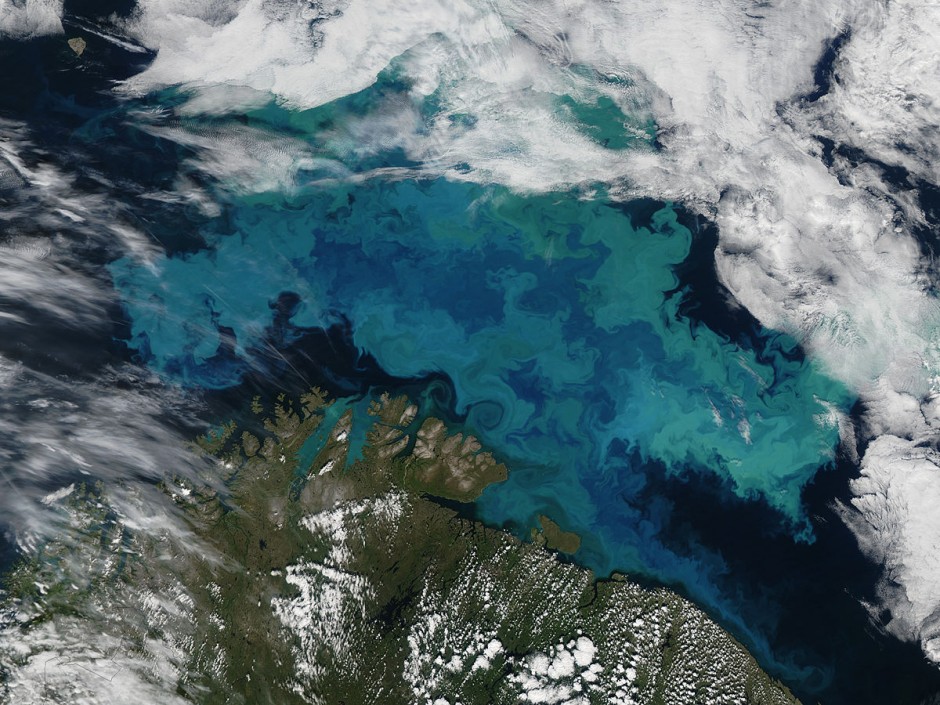
Barents Sea plankton bloom: sub-mesoscale flows may be responsible for the twisted, turquoise contours of this bloom (Credit: Jeff Schmaltz, MODIS Land Rapid Response Team, NASA GSFC)
Barents Sea plankton bloom: sub-mesoscale flows may be responsible for the twisted, turquoise contours of this bloom (Credit: Jeff Schmaltz, MODIS Land Rapid Response Team, NASA GSFC)
There is one outstanding problem with this technique though, as the very-small scale or sub-mesoscale marine processes are not well represented in global ocean models. Sub-mesoscale interactions take place on a scale so small, that computational models are unable to resolve them. Short for sub-medium (or ‘sub- meso’) length flows – the smaller flows in question are on the scale of 1-10 km. They are difficult to measure and observe, but their effects are seen in satellite imagery as they twist and turn beautiful blooms of marine algae.
Sub-mesoscale phenomena play a significant role in vertical nutrient supply – the vertical transfer of nutrients from nutrient-rich deep waters to light-rich surface waters where plankton photosynthesise. This is a major area of interest since the growth of marine plants is limited by this ‘two-layered ocean’ dilemma. But the ocean is partially able to overcome this, which is where sub-mesoscale flows come in. Sub-mesoscale flows are important in regions with large temperature differences over short distances – when colder, heavier water flows beneath warmer, lighter water. This movement brings nutrient-rich water up to the light-rich surface. Therefore, accurately modelling these important small-scale processes is vital to studying their effect on ocean life.
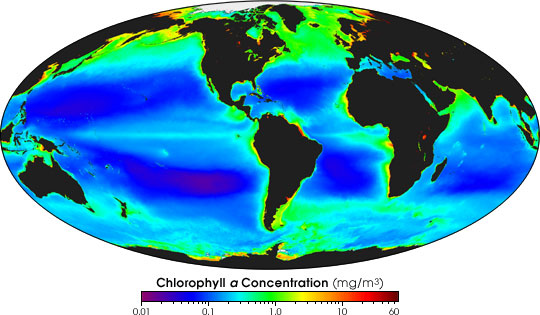
Global chlorophyll concentration: red and green areas indicate a high level or growth, whereas blue areas have much less phytoplankton. (Credit: University of Washington)
Global chlorophyll concentration: red and green areas indicate a high level or growth, whereas blue areas have much less phytoplankton. (Credit: SeaWiFS Project)
A group of scientists, led by Imperial College’s Jon Hill, probes the technique of biogeochemical ocean modelling and the issue of studying sub-mesoscale processes in a paper recently published in the EGU journal Ocean Science.  Rather than simply increasing the resolution of the models, the team suggests a novel method – utilising recent advances in adaptive mesh computational techniques. This simulates ocean biogeochemical behavior on a vertically adaptive computational mesh – a method of numerically analysing complex processes using a computer simulation.
What makes it adaptive? The mesh changes in response to the biogeochemical and physical state of the system throughout the simulation.
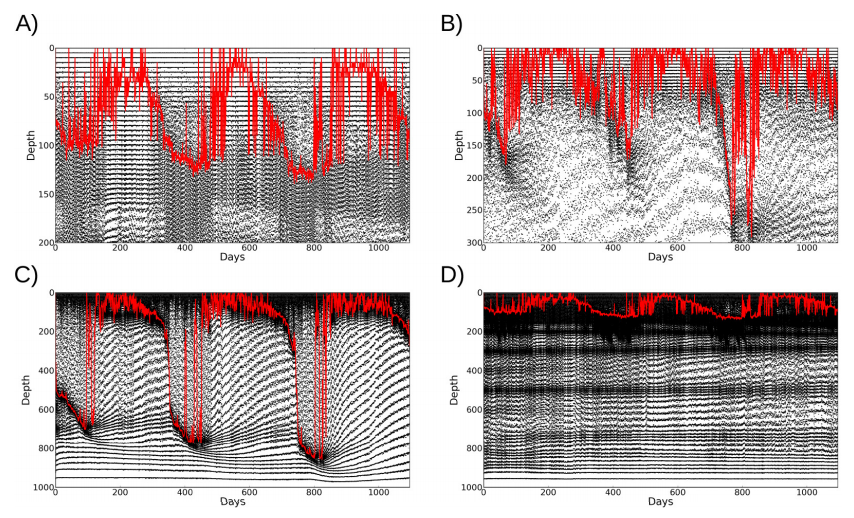
Their model is able to reproduce the general physical and biological behavior seen at three ocean stations (India, Papa and Bermuda), but two case studies really showcase this method’s potential: observing the dynamics of chlorophyll at Bermuda and assessing the sinking detritus at Papa. The team changed the adaptivity metric used to determine the varying mesh sizes and in both instances. The technique suitably determined the mesh sizes required to calculate these sub-mesoscale processes. This suggests that the use of adaptive mesh technology may offer future utility as a technique for simulating seasonal or transient biogeochemical behavior at high vertical resolution – whilst minimising the number of elements in the mesh. Further work will enable this to become a fully 3D simulation.
Comparison of different meshes produced by adaptive simulations: (a) Bermuda, taking the amount of chlorophyll into account (b) the original adaptive simulation at Bermuda, without taking chlorophyll into account (c) adaptive simulation at Papa, taking the amount of detritus into account (d) the original Papa simulation, without taking detritus into account. (Credit: Hill et al, 2014)
Comparison of different meshes produced by adaptive simulations: (a) Bermuda, taking the amount of chlorophyll into account (b) the original adaptive simulation at Bermuda, without taking chlorophyll into account (c) adaptive simulation at Papa, taking the amount of detritus into account (d) the original Papa simulation, without taking detritus into account. (Credit: Hill et al., 2014)
The fruits of this adaptive way of studying the small-scale ocean are already emerging as the secrets of the mysterious, sub-mesoscale ocean processes are probed. The ocean holds answers to questions about our planet, its future and the role of this complex, underwater world in the bigger, ecological picture – adapting to life and how we model it may just be the key we’ve been looking for.
By Nikita Marwaha
Reference:
Hill, J., Popova, E. E., Ham, D. A., Piggott, M. D. and Srokosz, M.: Adapting to life: ocean biogeochemical modelling and adaptive remeshing. Ocean Sci., 10, 323- 343, 2014

Friday, 30 May 2014

Goodbye Germany

I've spent the first half of this year working as a Science Communication intern at the European Southern Observatory (ESO) and it's sadly my last day in the German state of Bavaria. My time in Munich has completely flown by. I watched the seasons change from icy and dark winter and then springtime blossom, to the summer sun. It's hard to believe that I'm leaving soon but I'd say the time has passed by in a flash due to my love of the work, city and people I've met here. 


The flags of ESO's 15 member states stood tall in the morning, Munich springtime sun this particular day  a Committee Meeting was taking place and the flags are saved for such occasions. I've been told that the winter this year was exceptionally mild compared to chilly Munich standards and spring definitely sprung early this year as the city has been in full bloom.

I arrived in Munich on New Years Day and had some incredible opportunities such as visiting the Columbus Control Centre and the stunning Austrian city of Vienna,  but most importantly I learnt first-hand how to communicate cutting-edge astronomical science to the masses and how to do it well.


The people I've met and friends I've made have made me feel at home in this new city and I'm looking forward to returning one day, hopefully in the near future. The past 5 months have been an incredible learning curve both personally and professionally — I've gained a range of skills and experiences that I believe will better equip me for whatever lies in store for me next. 

Adorable teddy in lederhosen — the perfect leaving present! 


Speaking of what's next... I'm flying to my summer home of Montreal this weekend as I begin work at the International Space University (ISU) Space Studies Program (SSP) 2014The summer course is an intense 9-week educational immersion into the space industry. I actually was a student of this summer program back in 2012. You can read my blog post on my Florida space camp story here


This time around though, I'll be returning as a Teaching Associate for the Human Performance in Space (HPS) Department. I'll be sure to write a blog post with more details very soon :) For now though, I'm not quite ready to leave Munich, but looking forward to some change.


-Nikita

Tuesday, 4 March 2014

Clues to a Cosmic Crime


Not so long ago, I travelled to the picturesque town of Tergensee. Nestled beside the Alps, it is home to the recording studio used by the European Southern Observatory (ESO) to film the video podcast series - ESOcast and Hubblecast


These videos tell the stories from the frontline of astronomy from both ESO and  NASA/ESA Hubble Space Telescope perspectives  using spectacular graphics, witty metaphors and awe-inspiring scientific information.


We spent the day with Dr. Joe Liske, otherwise known as 'Dr J' the narrator of both podcasts as he narrated scenes against the studio's green screen. 

I co-wrote the script for Hubblecast Episode 72: Clues to a Cosmic Crime and was lucky enough to make a cameo appearance in the video!

This episode of Hubblecast witnesses a cosmic crime in action, as a spiral galaxy moves through the heart of galaxy cluster named Abell 3627. The cluster has no mercy on its galactic visitor as it rips the spiral's entrails out into space, leaving bright blue streaks as telltale clues to this cosmic crime.

 As someone that watched these videos online before joining ESO, it was a great behind-the-scenes insight into the production work that goes into creating these magnificent pieces of science communication. 


The Hubblecast is out today, you'll understand why Dr. J looks so windswept in the photo above when you watch Hubblecast Episode 72: Clues to a Cosmic Crime below or on YouTube here. My cameo appearance is at 2:42 :)


- This is Nikita, signing off for Making Apple Pie From Scratch, 'once again nature has surprised us beyond our wildest imaginations'.

Friday, 14 February 2014

München

It's been a month and a half since I moved from London to Munich on New Years Day. Time has flown past and I'm already finding myself giving people (wrong) directions around town! 
Occasionally, I look back to my first few days at work when everything that seems so clear to me now was all new information and realise how much I've already learnt in this short time. The European Southern Observatory (ESO) is a wonderful place to grow professionally and I can only imagine the perspective I'll have on my last day — leaving as a better writer than before. 

Sitting at the forefront of cutting-edge astronomical research of the Southern skies incredible new discoveries, exciting projects and magical images of the Universe are ESO's forté. One such project that I'm working on is the ESO Ultra HD Expedition, which is the journey of four world renowned astrophotographers to Chile in order to capture the magnificent ESO sites in all their grandeur . A week or so ago, Christoph Malin, one of the talented ESO Photo Ambassadors embarking upon the trip paid a visit to the office where he took some photos of us hard at work :) 
Living in a sleepy village outside Munich city centre means that I am always a tourist whenever I visit town. The weather has been unusually warm, but I'm not complaining!
I thought I'd share these snippets of my daily life as a short glimpse into working and living in Munich :)

-Nikita

Tuesday, 11 February 2014

From Earthlings to Martians: How Will Living On The Red Planet Affect Our Human Bodies?


As the next giant leap for humankind, the colonization of Mars receives a great deal of attention. When discussing the settlement of Mars, it is important to consider how the Martian environment will affect our human bodies in the long-term — a subject that does not receive as much coverage as colonization itself, yet is vital to ensuring our survival when we get there.
The Red Planet is the next natural step in humanity's exploration of the cosmos - however living on the surface as humans adapted to life on Earth is medically challenging   (Credit: NASA).
The Red Planet is the next natural step in humanity’s exploration of the cosmos – however living on the surface as humans adapted to life on Earth is medically challenging (Credit: NASA).

One-Way Ticket to Mars

The notion of leaving the cradle of humanity and settling in greener – or in this case redder – pastures on the fourth rock from the Sun has sparked novels, movies, research facilities, and now one-way missions. We have been conjecturing about life on Mars for centuries and recently, ‘Mars to Stay’ missions have been proposed by commercial entities in an attempt to bring these dreams to life and finally send humans on a trip to Mars with no return.  One such example is the non-profit foundation Mars One, whose goal is to establish a human settlement on Mars by 2025. It has stirred great interest with its optimistic roadmap of giving four volunteers a one-way ticket for a 210 day journey to the Red Planet every 26 months to spend the rest of their lives on Mars.

The Human Body and Gravity

Medically-speaking, getting there is essentially the easy part. The current six-month rotation on-board the International Space Station was partly designed so that it reflects the time taken to get to Mars, resulting in greater knowledge on what state an individual would arrive at Mars in. Physiological effects aboard the ISS range from muscle atrophy to osteoporosis and negative effects on the balance and cardiovascular system. With these mitigated for to some extent, such signs of the body adjusting to daily life without gravity are in synchrony with those likely to be experienced on a journey to Mars. As a result, the trip itself will not be so different to living on board the ISS — however the consequences of travelling beyond low Earth orbit and then living on Mars is far less familiar territory in space research. After a long space flight, astronauts find it difficult to stand and orientate themselves in the weight of Earth’s gravity.  A crew of post-mission specialists are ready to assist astronauts upon landing on Earth, but this will not be the case for the first settlers on Mars. The surface gravity of Mars is 38% that of Earth. That might make it slightly easier on landing, but in the long run, the full force of gravity that our bodies have adapted to will not be present to re-strengthen the astronauts’ cells, bones, and muscles as they readapt to a gravity environment. Adjusting to this lower level of gravitational pull on Mars may cause a physiological change in the astronauts’ bone density, muscle strength, and circulation making it impossible to survive under Earth conditions if they were to ever return.
Mars One aims to establish human settlement by 2025 displayed in this artist's illustration of the Mars One habitat (Credit: Mars One/Bryan Versteeg).
Mars One aims to establish human settlement by 2025 displayed in this artist’s illustration of the Mars One habitat (Credit: Mars One/Bryan Versteeg).

Earthlings or Martians?

The side-effects of travelling to, landing, and living on Mars are far greater in terms of both psychology and physiology. Travelling outside of Earth’s protective magnetic field to a distance so great that our planet is no more than a speck on the horizon will have a profound effect on the crew.
Aboard the ISS, if astronauts are feeling down, family and friends are simply a phone call away. The astronauts are also able to change their perspective by basking in the beauty of the revolving planet beneath them. However, as Earth shrinks to merely a dot on the horizon and the crew begin to live and work on the surface on Mars, the time delay across the vast expanse of space increases and eventually phone calls with loved ones become impractical. With communication signals taking between 3 and 22 minutes to travel each way, the ability to sustain a real conversation with anybody on Earth is not an option ever again.
This may eventually change the way that the crew view themselves. Psychologically, it is speculated that they will become Martians within weeks and will view themselves as a separate entity from Earthlings. The psychological isolation experiment Mars-500 explored this and other side-effects of crew isolation during a year and a half simulation of a round-trip mission to Mars.
Romain Charles, who along with Diego Urbina and four other crew members spent 520-days in the Mars mission simulation, shared his thoughts on the defining moment when they felt separate from the outside world.

It’s a tough question as we didn’t have any windows (or a simulated window) in our modules. Diego created an animation which allowed us to have a better understanding of what we would be able to see (or not see) but it came a bit later…I would say that, it’s not really the view of the Earth that changed our perspective. For me, the moment when we couldn’t phone the control center brought more “distance” between our crew and the world around than any window.
Advancements in virtual reality technologies may aid the crew in maintaining their mental health and stimulate their sensory systems, providing the ability to virtually transcend to a familiar location on Earth that has fond memories associated with it.
This is the Mars Desert Research Station (MDRS), located in the Utah Desert it is one of the four Mars-like bases scattered across the globe that gathers key research into life on Mars including fields such as biology and geology  (Credit: The Mars Society).
This is the Mars Desert Research Station (MDRS), located in the Utah Desert it is one of the four Mars-like bases scattered across the globe that gathers key research into life on Mars including fields such as biology and geology (Credit: The Mars Society).

The Environment of Mars

In order to assess the physiological effects of living on the surface of Mars, the Martian environment must be considered. Although it is orbiting 50% further away from the Sun and is 11% smaller than Earth, Mars is remarkably similar to our blue marble. With polar ice caps, seasonal changes, and weather patterns, it appears to be relatively comparable.
However, the absence of an ozone layer and liquid water are both extreme factors in the safety of astronauts. The presence of ‘superoxides’ that break down in the presence of ultraviolet radiation in Martian soil and a much lower level of thermal inertia on Mars also makes it difficult to predict how the human body will cope in such an environment. Martian dust devils, monster columns of spiraling red-brown sand and dust ten times larger than tornadoes found on Earth are predicted to also pose a threat to Martian settlers.
Currently exploring the surface of the Red Planet is NASA’s Curiosity rover. Its radiation-detecting instrument Radiation Assessment Detector (RAD) collected data that suggests that the risk of radiation exposure on a 180-day each-way return trip to Mars with 500 days on the surface would expose astronauts to a cumulative radiation dose of about 1.01 sieverts. However, the long-term radiation dosage for those dwelling permanently on the red planet requires much further investigation.
Simulations of life on Mars in analogue Earth environments such as the Mars Analog Research Station (MARS) project established by the Mars Society help to reveal the mystery behind life on Mars. This is a global program of Mars exploration in four Mars base-like habitats located in the deserts of the Canadian Arctic, the Utah Desert, the Australian outback, and Iceland — allowing novel insights to be gained and field research to be conducted by rotating crews. Suchresearch in Mars-like environments is a valuable source of knowledge for researchers and inspiration for enthusiasts with the vision of human exploration of Mars.
The Martian habitat will undoubtedly need to protect the crew from long-term radiation exposure. Using Mars One proposes to solve this challenge via a habitat covered by a layer of soil that provides shielding against galactic cosmic rays. They state that sixteen feet (5 meters) of Martian soil provides the same protection as the Earth’s atmosphere — equivalent to 1,000 grams per square cm (227.6 ounces per square inch) of shielding. If the colonists spend two hours a day outside the habitat, their individual exposure adds up to 22 mSv per year. Key research into habitat and spacesuit technology is to be done in order to provide sufficient radiation shielding so that the settler is made safe when both indoors and outside on the surface of Mars.

Future Research

Eventually, humans will journey to Mars and settle on our neighboring planet; however this journey remains the greatest challenge of our time at present. In order to thrive on the Red Planet in the future, it is vital that thorough research into the Martian environment and its interaction with the complex human body is carried out now. In particular, long-term isolation studies that simulate not only the journey to Mars, as in the case of the Mars 500 experiment, but also daily life on the surface of Mars as a human settler are needed. Medical experiments investigating the environmental effects of the Martian environment such as prolonged radiation and reduced gravity should also be carried out.
Understanding these effects is critical to maintaining the health of those pioneering few that are bold enough to take the next step in humanity’s journey through the cosmos and it will ensure the survival of our species for many generations to come, as Earthlings and Martians.

Written by Nikita Marwaha for Space Safety Magazine

-Nikita

Tuesday, 28 January 2014

Lost In Space

January has been a flurry of snow, early nights, getting lost, astronomy, writing and most of all learning.


 From learning how to write succinct yet compelling European Southern Observatory (ESO) press releases to navigating the U-Bahn, using Euros and recalling my GCSE German lessons— I'm getting more settled into life in Munich and will be posting more regularly in February. For now, here's a photo of what is getting me through these icy winter months:


 Hi, my name is Nikita and I'm a Nutella-holic.


-Nikita


Related Posts Plugin for WordPress, Blogger...