Showing posts with label science. Show all posts

Thursday, 6 November 2014

Köln - The Human Side of Space at DLR & ESA

 I recently visited the beautiful German city of Köln (or Cologne). Sitting on both sides of the River Rhine, Köln has always been on my list of favourite cities in the world. Its unique skyline is a blend of quaint, historical architecture and modern, high-rise buildings  making it a European city definitely worth visiting. 


As well as being a cool city, Köln is also home to the headquarters of the German Space Agency or Deutsches zentrum für Luft- und Raumfahrt (DLR) and the European Space Agency's (ESA) European Astronaut Centre (EAC) -  making it that much cooler if you ask me :)

During my time in Cologne, I visited both DLR HQ and the EAC ESA centre. The last time I came here was during the ESA Space Medicine Workshop in 2011 when I was still a Biology student at the University of Birmingham. It was great to return over 3 years later now that I work in the space industry and to see it with new, more knowledgeable eyes. 

I paid a visit to the StABLE Study at DLR in particular. The study aims to investigate the impact of a changing rotational axis upon brain perfusion and fluid shift to the lower extremities. In essence, it is trying to figure out the extent to which the Short-Arm Human Centrifuge (SAHC) can be used as a potential countermeasure to the negative impacts of space on the human body. 

Ranging from muscle and bone loss to fluid shift, the SAHC is proposed as an ideal countermeasure to these space side-effects thanks to its short radius. Yet, the extent to which it may be so is still unknown. I watched subjects being spun for science at DLR  work that will better enable scientists to understand the effects of this centrifuge on the human body, especially when the central point of rotation is altered.

Next up on my space agency tour of Köln was the EAC. Home to all things astronaut — the ESA centre is in fact led by ESA astronaut Frank de Winne. As a powerhouse of human spaceflight, the EAC is where astronauts are selected, trained and provided with medical care & support for themselves as well as their families both before and during their time in space.

The Neutral Buoyancy Facility at the EAC is used to simulate weightlessness during astronaut training. It is a great way for astronauts to practice spacewalking and although you can still feel the pull of gravity whilst underwater, it is the closest you can get to microgravity on Earth.

 I also pretended to be Commander of the Soyuz spacecraft - the vehicle that carries astronauts to and from the International Space Station. Developed for the Soviet Space Program in the 1960s, it is still in use today!

My friend Antonio Fortunato works in the position of EUROCOM - or European Spacecraft Communicator. Here, he relays information to the International Space Station from the Columbus Flight Control Team in Munich. When I was there, the station was threatened by a piece of debris - a problem that is unfortunately ever increasing. Teams on Earth worked hard to ensure that the space station successfully dodged the debris - using the Automated Transfer Vehicle (ATV) to conduct a debris avoidance maneuver - boosting the station to a higher orbit. Science: 1, Real-life Gravity movie: 0 


Another example of the work conducted by people on Earth for life in space is demonstrated by my friend Romain Charles (pictured above). He spent 520 days in crew isolation from 2010-2011 as part of the first simulation of a manned mission to Mars and back. Named Mars 500 - the psychological experiment kept the crew of 6 locked in their spacecraft as they simulated a return trip to the Red Planet. An incredible achievement!

As a key player in European space activities, Germany definitely is the place to be to learn more about human spaceflight. My trip to DLR and the EAC was a unique insight into the process, people and research involved with putting a human in orbit around Earth. The human side of space is very much present in Germany and I believe that such work is not only important, but vital to advancing as a species together - here on Earth and beyond.


Tschüss!

-Nikita


Tuesday, 30 September 2014

International Astronautical Congress 2014


Toronto will become the center of the universe this week as the city hosts the 65th International Astronautical Congress (IAC) 2014. Taking place from September 29th to  October 3rd, the annual international convention will bring space to Canada. This year’s theme, Our World Needs Space, covers a plethora of topics — many of which are related to space safety. Ranging from human spaceflight to space debris, the conference is an opportunity for space professionals and students from across the globe to network, share their ideas, and learn with the global space community.
The one week long conference will include a variety of symposia, each containing a series of sessions. These talks will be given by researchers and experts in their fields. Several of the symposia follow the theme of space safety — including the Space Exploration, Human Exploration of the Solar System, Space Debris and Human Spaceflight symposia.  Looking into where humankind has gone and may go in the future, as well as the societal implications of discovering extraterrestrial intelligence are important topics of discussion at the IAC.

Breaking It Down

The Space Exploration Symposium (A3) covers the current and future robotic missions and material plans for initiatives in the exploration of the Solar System. Coordinated by Dr. Christian Sallaberger from Canadensys Aerospace Corporation and Prof. Bernard Foing from ESA/ESTEC, this symposium covers exploration of the solar system, including the Moon, Mars, and small bodies. Speakers from NASA and the German Aerospace Centre DLR will present their research as part of this symposium.
The Human Exploration of the Solar System (A5) will tackle the strategic plans, architectural concepts, and technology development for human exploration of the Moon, Mars, Lagrangian Points, and near Earth objects (NEOs).  These are important areas of discussion, especially within the area of space safety since the methods by which humans explore the solar system should maintain an appropriate standard of safety.
The Space Debris (A6)  symposium addresses the wide range of technical issues associated with space debris. Measurements, modeling, and risk assessment in space and on the ground are addressed by speakers from organizations such as Boeing and SwissSpace Systems and universities such as the University of Surrey and Concordia University.  Reentry; hypervelocity impacts; and protection, mitigation, and standards and space surveillance will also be presented and discussed as a part of the Space Debris Symposium.
The Human Spaceflight Symposium (B3) symposium addresses all practical aspects of human spaceflight. Mr. Christian Bank from EADS Astrium Space Transportation GmbH and Mr. John Uri from NASA are coordinating the symposium, which will include talks on governmental and commercial human spaceflight programs as well as advanced systems, technologies, and innovations for human spaceflight.

Top Picks

This wide variety of space safety-related topics being discussed at the IAC demonstrates the importance of such a conference in terms of connecting and inspiring like-minded people.  The session that I am most looking forward to is the Heads of Agencies plenary event where leaders of the world’s major space agencies will outline the latest developments in their countries. The session may also provide an interesting variety of perspectives on the future of human spaceflight, including the International Space Station. Another highlight of the week for me is theNext Generation Plenary – Innovations in Exploration on Tuesday at 13:30. Moderated by former Canadian Space Agency astronaut Chris Hadfield, the panel is comprised of a selection of young professionals who will discuss why they believe their ideas will change the way we explore space and how space impacts life on Earth. This interaction between a world-renowned astronaut and the next generation of space leaders is a powerful method of generating novel ideas through discussion.

Space Safety Magazine at IAC

Along with 3,000 participants from over 70 countries attending the week-long conference, there will also be presentations from Space Safety Magazine contributors including Matteo Emanuelli, Andrew Henry, Morris Jones, and Merryl Azriel. Matteo will present The NEO Threat: An Effective Public Communication Strategy dealing with NEO education and the ways in which to effectively communicate such a threat to the public three years in advance. Andrew will conduct a workshop on Earth Observation Data on Thursday afternoon and Morris Jones will present a paper on Cryptosociology and Extraterrestrial Civilizations Wednesday afternoon.  Merryl Azriel will present the Space Safety Magazine-led initiative to recognize the International Space Station (ISS) Partnership with a Nobel Peace Prize award. With a presentation entitled Advocating for a Nobel Peace Prize: An Innovative Approach to Promoting Global Space Engagement, Merryl will delve into the unique value of the ISS partnership and the importance of increasing the public’s awareness of the value of the most complex peacetime collaboration ever undertaken by humankind.
Founded in 1951 by the International Astronautical Federation (IAF), the IAC is a joint effort by the IAF and a local Host. This year this it is the Canadian Aeronautics and Space Institute (CASI) that is coordinating the logistics in Toronto and ensuring that the North American aspect of IAC 2014 is a prominent characteristic of this year’s conference.

Written by Nikita Marwaha for Space Safety Magazine

Tuesday, 17 June 2014

Geosciences Column: Meshing models with the small-scale ocean

The latest Geosciences Column is brought to you by Nikita Marwaha, who explains how a new generation of marine models is letting scientists open up the oceans. The new technique, described in Ocean Science, reveals what’s happening to ocean chemistry and biology at scales that are often hard to model…
Diving into the depths of the ocean without getting your feet wet is possible through biogeochemical modelling – a method used by scientists in order to study the ocean’s living systems. These simulated oceans are a means of understanding the role of underwater habitats and how they evolve over time. Covering nutrients, chlorophyll concentrations, marine plants, acidification, sea-ice coverage and flows, such modelling is an important tool used to explore the diverse field of marine biogeochemistry.
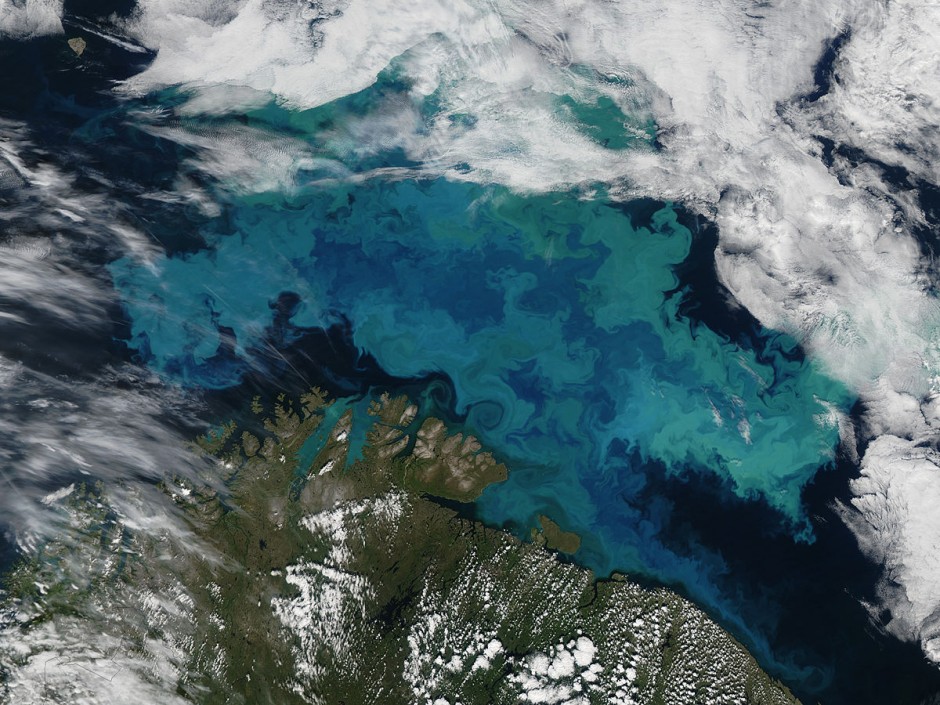
Barents Sea plankton bloom: sub-mesoscale flows may be responsible for the twisted, turquoise contours of this bloom (Credit: Jeff Schmaltz, MODIS Land Rapid Response Team, NASA GSFC)
Barents Sea plankton bloom: sub-mesoscale flows may be responsible for the twisted, turquoise contours of this bloom (Credit: Jeff Schmaltz, MODIS Land Rapid Response Team, NASA GSFC)
There is one outstanding problem with this technique though, as the very-small scale or sub-mesoscale marine processes are not well represented in global ocean models. Sub-mesoscale interactions take place on a scale so small, that computational models are unable to resolve them. Short for sub-medium (or ‘sub- meso’) length flows – the smaller flows in question are on the scale of 1-10 km. They are difficult to measure and observe, but their effects are seen in satellite imagery as they twist and turn beautiful blooms of marine algae.
Sub-mesoscale phenomena play a significant role in vertical nutrient supply – the vertical transfer of nutrients from nutrient-rich deep waters to light-rich surface waters where plankton photosynthesise. This is a major area of interest since the growth of marine plants is limited by this ‘two-layered ocean’ dilemma. But the ocean is partially able to overcome this, which is where sub-mesoscale flows come in. Sub-mesoscale flows are important in regions with large temperature differences over short distances – when colder, heavier water flows beneath warmer, lighter water. This movement brings nutrient-rich water up to the light-rich surface. Therefore, accurately modelling these important small-scale processes is vital to studying their effect on ocean life.
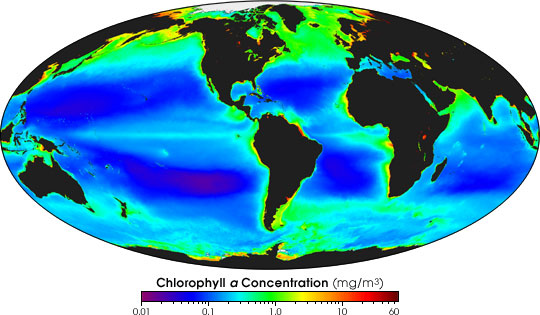
Global chlorophyll concentration: red and green areas indicate a high level or growth, whereas blue areas have much less phytoplankton. (Credit: University of Washington)
Global chlorophyll concentration: red and green areas indicate a high level or growth, whereas blue areas have much less phytoplankton. (Credit: SeaWiFS Project)
A group of scientists, led by Imperial College’s Jon Hill, probes the technique of biogeochemical ocean modelling and the issue of studying sub-mesoscale processes in a paper recently published in the EGU journal Ocean Science.  Rather than simply increasing the resolution of the models, the team suggests a novel method – utilising recent advances in adaptive mesh computational techniques. This simulates ocean biogeochemical behavior on a vertically adaptive computational mesh – a method of numerically analysing complex processes using a computer simulation.
What makes it adaptive? The mesh changes in response to the biogeochemical and physical state of the system throughout the simulation.
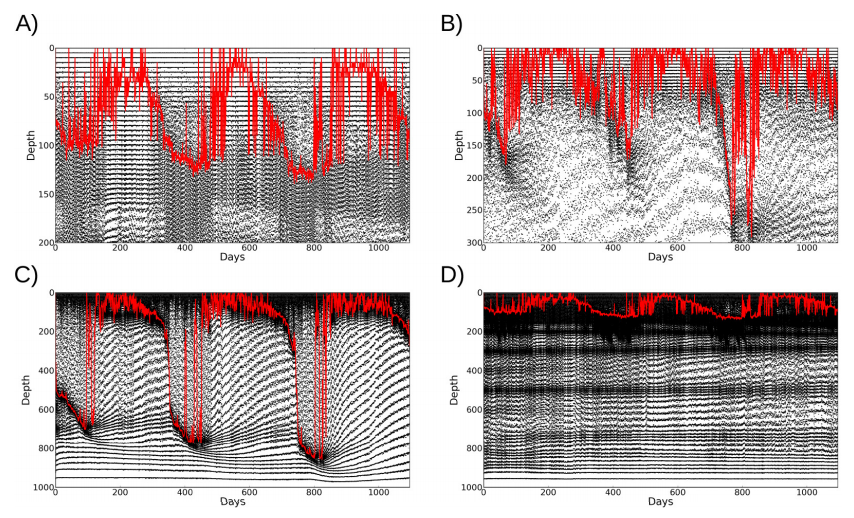
Their model is able to reproduce the general physical and biological behavior seen at three ocean stations (India, Papa and Bermuda), but two case studies really showcase this method’s potential: observing the dynamics of chlorophyll at Bermuda and assessing the sinking detritus at Papa. The team changed the adaptivity metric used to determine the varying mesh sizes and in both instances. The technique suitably determined the mesh sizes required to calculate these sub-mesoscale processes. This suggests that the use of adaptive mesh technology may offer future utility as a technique for simulating seasonal or transient biogeochemical behavior at high vertical resolution – whilst minimising the number of elements in the mesh. Further work will enable this to become a fully 3D simulation.
Comparison of different meshes produced by adaptive simulations: (a) Bermuda, taking the amount of chlorophyll into account (b) the original adaptive simulation at Bermuda, without taking chlorophyll into account (c) adaptive simulation at Papa, taking the amount of detritus into account (d) the original Papa simulation, without taking detritus into account. (Credit: Hill et al, 2014)
Comparison of different meshes produced by adaptive simulations: (a) Bermuda, taking the amount of chlorophyll into account (b) the original adaptive simulation at Bermuda, without taking chlorophyll into account (c) adaptive simulation at Papa, taking the amount of detritus into account (d) the original Papa simulation, without taking detritus into account. (Credit: Hill et al., 2014)
The fruits of this adaptive way of studying the small-scale ocean are already emerging as the secrets of the mysterious, sub-mesoscale ocean processes are probed. The ocean holds answers to questions about our planet, its future and the role of this complex, underwater world in the bigger, ecological picture – adapting to life and how we model it may just be the key we’ve been looking for.
By Nikita Marwaha
Reference:
Hill, J., Popova, E. E., Ham, D. A., Piggott, M. D. and Srokosz, M.: Adapting to life: ocean biogeochemical modelling and adaptive remeshing. Ocean Sci., 10, 323- 343, 2014

Sunday, 5 January 2014

New Year, New City

Happy New Year!

I hope that your first few days of 2014 have been wonderful and full of keeping those new resolutions. The New Year is usually a time for new beginnings, outlooks and fresh starts and I began 2014 with a flight to my new home for the next few months, Munich! 


On New Years Day, I flew 1 hour and a half away from my home city of London to Munich, the capital of the German state of Bavaria. It is also home to the world's most productive intergovernmental astronomy organisation and my new work place, the European Southern Observatory (ESO). Comprised of 15 member states, ESO operates a suite of the world's most advanced telescopes in the world which scan the Southern skies and probe the Universe for untold stories waiting to be discovered. With telescopes in three sites in Chile - La SillaParanal and Chajnantor, ESO is working on painting an ever growing picture of the cosmos. 


It is vital that the findings revealed from the hidden universe are communicated to the public and this is where my department comes in. I am a Science Communication Intern within the education & Public Outreach Department (ePOD) of ESO. You can read biographies of the department members, including myself on the ESO website here. It is within ePOD that I am learning more about the science communication process and working with the team to produce press releases, popular articles, image/video captions and scripts in order to effectively communicate scientific information to a broader audience.


I'm very happy that I'm working in a field that I've pursued since a young age and I hope I can inspire others who have similar aspirations to continue to strive to achieve them. 


Auf Wiedersehen!


-Nikita

Saturday, 28 December 2013

ISS for the Nobel Peace Prize


A project I am currently involved with is the ISS for the Nobel Peace Prize initiative. The International Space Station, or ISS is the largest peace-time endeavour in human history and a model for international cooperation. We aim to promote the ISS as a candidate for the Nobel Peace Prize and hopefully one day win the prestigious award.

15 nations formed the ISS Partnership with: Belgium, Canada, Denmark, France, Germany, Italy, Japan, the Netherlands, Norway, Russia, Spain, Sweden, Switzerland, the United Kingdom, and the United States. These nations worked together despite cultural and geographical differences to build, finance and launched the orbiting science laboratory and home. 

As the largest structure built by humans in space, it serves as a permanent outpost within the vacuum of space. Humans have lived peacefully in space everyday since the year 2000! Such a magnificent testament to  peace and cooperation both on Earth and in space is one that is worthy of the Nobel Peace Prize and it is the goal of the ISS for Nobel Peace Prize initiative to secure global recognition of this technological feat that has brought scientific and economic benefits to all partners as well as inspiring people across the globe to dream higher. 

Click here if you would like to learn more about how you can help to nominate the ISS for the Nobel Peace Prize and find us on social media sites Twitter and Facebook also. Follow the hashtags #ISS and #ISS4NobelPrize for more information.

-Nikita

Friday, 20 December 2013

Snapshots of the Universe


Is the best way to teach physics to kids to make them think that they're just playing a fun game? Sneaky, but effective. With children (and me) glued to their screens with addictive games such as Candy Crush and Minion Rush, why not inject some space education into the games market?

Stephen Hawking has gone to great lengths to promote science through traditional methods such as books and television however he has now entered the software arena to inspire young scientists. The theoretical physicist and Professor teamed up with Random House to create 'Snapshots of the Universe', his first official app.

The iPad app contains mini-games, videos and text that illustrate a plethora of fundamental space concepts. Ranging from learning about G-force with Einstein and putting planets into orbit to master the theory of relativity, the game presents physics and space in a fun and engaging way. Video explanations from Hawking himself are available for the user to delve further into the depths of space.

" Based on the work and writings of Stephen Hawking, this app teaches both adults and students the basic theories that govern our lives on Earth as well as the movement of the stars and planets. You can play and learn at the same time in each of the eight experiments included in Snapshots of the Universe:

- Spin planets in orbit with your own solar system
- Drop objects with Galileo to learn about gravity
- Let Einstein feel some G-force in outer space
- Search for black holes in the constellation of Leo
- Discover Einstein’s warped worldview
- Plus more…"

I think that games such as these are onto something. With increasing evidence on the declining attention span of the younger generation and their increasing ability to use technology such as iPads, teaching through games that encourage learning through entertainment may well be the future of teaching science, technology, engineering and mathematics (STEM) fields.

Published by Random House, the app is available on iTunes for $4.99.

-Nikita


Tuesday, 5 November 2013

Could A Vegetable Compound Protect Against the Effects of Radiation?


DIM could be used to protect astronauts during space travel (Credits: NASA)
DIM could be used to protect astronauts during space travel (Credits: NASA).

A compound found in cruciferous vegetables such as cabbage, broccoli, and cauliflower may be the key to radiation protection, scientists have found.
The compound, called 3’3-diindolymethane or DIM, is under investigation as a cancer preventative agent. Used as a potential medical countermeasure, DIM may be able to prevent or mitigate acute radiation syndrome due to whole body exposure.
Previously studied as a cancer prevention agent, this is the first instance in which DIM has been considered as a radiation protector.
One of the study’s author Dr. Eliot Rosen of Georgetown Lombardi Comprehensive Cancer Center in the US describes why this new development holds great intrigue and significance: “I find it fascinating that a known cancer preventive agent (DIM) has powerful radiation protection properties and wonder if there is a relationship in the case of DIM between its radioprotection and cancer prevention mechanisms.”
The early stage laboratory study administered DIM to rodents in a multidose schedule in order to identify whether DIM could protect against the effects of exposure to radiation.
Results from the experiment demonstrated that the compound protected the animals against lethal doses of body irradiation up to 13 Gy. This was the case whether DIM dosing was initiated before or up to 24 hours after radiation exposure. The irradiated rodents injected with DIM survived longer than those left untreated.
This suggests that DIM may be useful in protecting against the effects of radiation. Rosen commented “DIM could potentially be used to protect normal (non-tumor) tissues against radiation therapy treatments for cancer.”
The compound functions uniquely from other radioprotectors and mitigators. ”DIM works in part by amplifying the normal DNA damage response that occurs when cells and tissues are irradiated. DIM also acts to prevent radiation-caused apoptosis, a type of programmed cell death. The first mechanism is novel among radiation protectors, though other protectants might also act to block apoptosis.”
DIM could protect normal tissues in patients receiving radiation therapy for cancer (Credits: CTCA).
The experimental evidence collected thus far supports DIM as a potential radioprotector and mitigator. In terms of the direction of future research, Rosen added: “We will work toward FDA approval of DIM as a radioprotectant and mitigator. This is a complex process that will involve determining the best way to deliver DIM (e.g. oral, subcutaneous, intramuscular) and other animal testing studies.”
It is uncertain whether an outcome similar to the irradiated rodents treated with DIM is possible in humans. However if so, the potential applications for DIM may venture into orbit as a radioprotector for astronauts exposed to the harsh environmentof space.
“Although speculative at this time, DIM could be used to protect against radiation received by astronauts during space travel (eg., cosmic radiation). One has to be careful because there are different types of radiation, and we don’t yet know whether DIM protects against all forms of radiation.”
With the duration of time that astronauts spend in space set to increase with future Mars and asteroid missions, DIM may provide a method of radiation protection that is sustainable and that can be grown in-situ due to its vegetable origins.
The findings are published in the journal Proceedings of the National Academy of Sciences.
Image credits: Charles Smith

Written for Space Safety Magazine by Nikita Marwaha

Thursday, 6 June 2013

Becoming a NASA Intern


For the past 3 weeks I've been interning at NASA Ames Research Center in the Silicon Valley, San Francisco. Renowned for its innovative approach, Ames is the perfect place for me to explore where I want my career to take me and to meet extra-ordinary people that can help me to identify this. 

Serving as the newest member of the NASA New Media Innovation Team (NMIT) I've been lucky enough to have the most interesting, creative and intelligent mentor, Dr. Yvonne Clearwater. With over 40 years of work at Ames, Yvonne joined Ames as a member of the International Space Station (ISS) design team and was the Principle Investigator on early ISS designs. As well as this, she developed the official NASA App, 'NASA on the (Flickr) Commons and the inspirational website NASA ArtSpace (found here: http://www.nasa.gov/connect/artspace/)

Together, we are working to increase public awareness and involvement in the creative cultural convergence of art, science and technology as it serves to inspire space exploration. We have been developing innovative projects to increase public communication and connection with NASA. In particular, utilising the powerful tool of new media platforms to increase public engagement with NASA Ames.

I'll be working here for 3 months and already have had the opportunity to go to a number of events at exciting places such as the SETI Institute: Search for Extraterrestrial Intelligence, Singularity University as well as meeting the Director of Ames Pete Worden and the NASA Administrator Charles Bolden!

Lunchtime conversations between the synthetic biologist to the neighbouring astrophysicist and their quantum computing friend have become an everyday occurrence for my fellow interns and I, and it's something I don't think I'll ever get used to hearing. It's s a daily reminder of the unique environment I'm in and I feel very fortunate to be in the midst of the ground-breaking research and technological advancement that is and will help us explore the Universe as well as sustain life as we know it on Earth.

-Nikita
Related Posts Plugin for WordPress, Blogger...