Showing posts with label biology. Show all posts

Tuesday, 17 June 2014

Geosciences Column: Meshing models with the small-scale ocean

The latest Geosciences Column is brought to you by Nikita Marwaha, who explains how a new generation of marine models is letting scientists open up the oceans. The new technique, described in Ocean Science, reveals what’s happening to ocean chemistry and biology at scales that are often hard to model…
Diving into the depths of the ocean without getting your feet wet is possible through biogeochemical modelling – a method used by scientists in order to study the ocean’s living systems. These simulated oceans are a means of understanding the role of underwater habitats and how they evolve over time. Covering nutrients, chlorophyll concentrations, marine plants, acidification, sea-ice coverage and flows, such modelling is an important tool used to explore the diverse field of marine biogeochemistry.
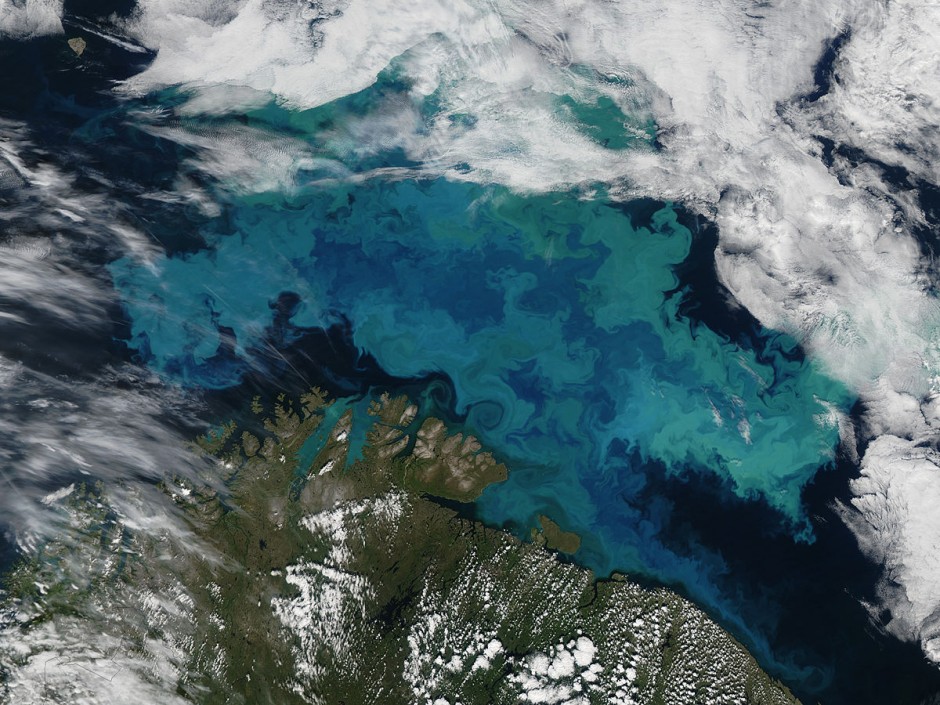
Barents Sea plankton bloom: sub-mesoscale flows may be responsible for the twisted, turquoise contours of this bloom (Credit: Jeff Schmaltz, MODIS Land Rapid Response Team, NASA GSFC)
Barents Sea plankton bloom: sub-mesoscale flows may be responsible for the twisted, turquoise contours of this bloom (Credit: Jeff Schmaltz, MODIS Land Rapid Response Team, NASA GSFC)
There is one outstanding problem with this technique though, as the very-small scale or sub-mesoscale marine processes are not well represented in global ocean models. Sub-mesoscale interactions take place on a scale so small, that computational models are unable to resolve them. Short for sub-medium (or ‘sub- meso’) length flows – the smaller flows in question are on the scale of 1-10 km. They are difficult to measure and observe, but their effects are seen in satellite imagery as they twist and turn beautiful blooms of marine algae.
Sub-mesoscale phenomena play a significant role in vertical nutrient supply – the vertical transfer of nutrients from nutrient-rich deep waters to light-rich surface waters where plankton photosynthesise. This is a major area of interest since the growth of marine plants is limited by this ‘two-layered ocean’ dilemma. But the ocean is partially able to overcome this, which is where sub-mesoscale flows come in. Sub-mesoscale flows are important in regions with large temperature differences over short distances – when colder, heavier water flows beneath warmer, lighter water. This movement brings nutrient-rich water up to the light-rich surface. Therefore, accurately modelling these important small-scale processes is vital to studying their effect on ocean life.
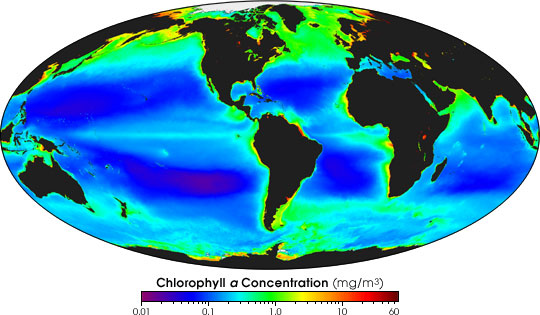
Global chlorophyll concentration: red and green areas indicate a high level or growth, whereas blue areas have much less phytoplankton. (Credit: University of Washington)
Global chlorophyll concentration: red and green areas indicate a high level or growth, whereas blue areas have much less phytoplankton. (Credit: SeaWiFS Project)
A group of scientists, led by Imperial College’s Jon Hill, probes the technique of biogeochemical ocean modelling and the issue of studying sub-mesoscale processes in a paper recently published in the EGU journal Ocean Science.  Rather than simply increasing the resolution of the models, the team suggests a novel method – utilising recent advances in adaptive mesh computational techniques. This simulates ocean biogeochemical behavior on a vertically adaptive computational mesh – a method of numerically analysing complex processes using a computer simulation.
What makes it adaptive? The mesh changes in response to the biogeochemical and physical state of the system throughout the simulation.
Their model is able to reproduce the general physical and biological behavior seen at three ocean stations (India, Papa and Bermuda), but two case studies really showcase this method’s potential: observing the dynamics of chlorophyll at Bermuda and assessing the sinking detritus at Papa. The team changed the adaptivity metric used to determine the varying mesh sizes and in both instances. The technique suitably determined the mesh sizes required to calculate these sub-mesoscale processes. This suggests that the use of adaptive mesh technology may offer future utility as a technique for simulating seasonal or transient biogeochemical behavior at high vertical resolution – whilst minimising the number of elements in the mesh. Further work will enable this to become a fully 3D simulation.
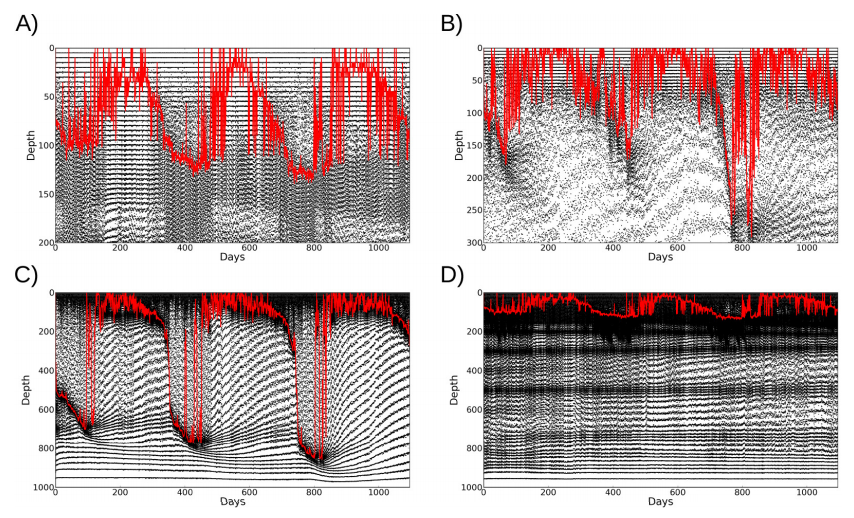
Comparison of different meshes produced by adaptive simulations: (a) Bermuda, taking the amount of chlorophyll into account (b) the original adaptive simulation at Bermuda, without taking chlorophyll into account (c) adaptive simulation at Papa, taking the amount of detritus into account (d) the original Papa simulation, without taking detritus into account. (Credit: Hill et al, 2014)
Comparison of different meshes produced by adaptive simulations: (a) Bermuda, taking the amount of chlorophyll into account (b) the original adaptive simulation at Bermuda, without taking chlorophyll into account (c) adaptive simulation at Papa, taking the amount of detritus into account (d) the original Papa simulation, without taking detritus into account. (Credit: Hill et al., 2014)
The fruits of this adaptive way of studying the small-scale ocean are already emerging as the secrets of the mysterious, sub-mesoscale ocean processes are probed. The ocean holds answers to questions about our planet, its future and the role of this complex, underwater world in the bigger, ecological picture – adapting to life and how we model it may just be the key we’ve been looking for.
By Nikita Marwaha
Reference:
Hill, J., Popova, E. E., Ham, D. A., Piggott, M. D. and Srokosz, M.: Adapting to life: ocean biogeochemical modelling and adaptive remeshing. Ocean Sci., 10, 323- 343, 2014

Thursday, 27 February 2014

What’s On the Space Menu? – Vegetables Grown in Space Deemed Safe to Eat


The History of Space Food


The long quest for adequate nutrition in space has taken astronaut consumption from toothpaste tubes and gelatin coated cubes to freeze-dried foods and now to the possibility of freshly-grown vegetables.
This ever-evolving space menu was well documented in Space Safety Magazine’s Space Food special earlier this year, covering the past, present, and future of space food — the struggles to achieve food that is nutritious, long-lasting and safe in the space environment has been a long one.
Early space food involved pre-packaged items that although technically safe and nutritious, were not as appetizing as fresh foods. (Credits: NASA)
Early space food involved pre-packaged items that although technically safe and nutritious, were not as appetizing as fresh foods.
(Credits: NASA)
The first space food used on missions consisted of vicious fluid packaged in aluminium tubes, similar to toothpaste tubes. The first man in space, Yuri Gagarin, tested the functionality of the digestive system in space with chocolate sauce and meat paste packaged in such tubes. Although effective for use in microgravity, these were deeply unpopular. Gelatin coated cubes and rehydratable freeze dried foods also made appearances early in the US space program. Available in flavors ranged from cereal to bacon and strawberry — these were not continued since they generated crumbs that posed an inhalation hazard in microgravity and also formed a sticky coating. On the other hand, the rehydratable freeze dried foods that followed were deemed unappetizing by astronauts. The experience and technology gained from these previous iterations of space food helped researchers hone these dense nutritional packages into items of recognizable, even appealing items on the space menu of today.

Achieving Edible Fresh Food in Space


The journey is far from over and the production of fresh food in space without resupply missions from Earth is the ultimate goal. However, we are now half-way there, as growing fresh food in space that is edible has now been successfully achieved. As RIA Novosti reports,Russian scientists have recently verified that several plants grown in space are safe for human consumption. The space grown vegetables range from peas and Japanese leafy greens to dwarf wheat — all of which passed tests on Earth for abnormalities or harmful microbes.
Margarita Levinskikh of the Institute of Biological Problems told the radio show The Voice of Russia that “The plants have been very developed, absolutely normal and did not differ a lot from the plants grown on Earth.” As a co-investigator on the NASA study to validate the Vegetable Production Unit (VPU), she works alongside scientists to ensure that the procedures and protocols used aboard the International Space Station (ISS) to grow fresh food maximise astronaut health and well-being.
The importance of not only growing but also testing the food grown by astronauts and cosmonauts is vital to our development as a space faring species. To assume such foods to be safe once grown in space is a dangerous risk to take. With plant growth affected by the microgravity environment in ways that we do not yet fully understand and microbial organisms known to develop into more virulent varieties under microgravity conditions, scientific investigation of food grown in space is mandatory during this developmental phase of consuming fresh food in space.
The Lada greenhouse, named after the Russian goddess of spring houses vegetables grown aboard the International Space Station. (Credits: NASA)
The Lada greenhouse, named after the Russian goddess of spring houses vegetables grown aboard the International Space Station.
(Credits: NASA)
Currently, vegetables are grown on board the International Space Station in a special greenhouse named Lada, after the Russian goddess of spring. The unit is equipped with removable root modules containing enough nutrients for several generations of crop-growth — astronauts send these modules back to Earth for analysis once the nutrients are used up. Biologists then probe the root modules and the plants’ leaves for contaminants which may originate from the space station’s environment.
“We have also gotten experience with the astronauts and cosmonauts eating the fresh food they grow and not having problems,” said crop scientist Bruce Bugbee who is also a co-investigator in the research, in an email to Popular Science. As a professor at Utah State University, Bugbee has worked on numerous studies of food grown in space. He adds in an email to Space Safety Magazine, “Since the earliest days of the long-term manned space program, space grown food has undergone an enormous amount of testing… to-date, we have been able to grow only small amounts of fresh food in space. We have long known that fresh food in the diet is important to health.  Dieticians have pushed for more fresh food in the diet in space.  Health professionals are concerned about the safety of a long-term diet of dried, stored food.  We have been working to be able to gradually change this diet.”
With human spaceflight missions sent to increase in duration as we venture further into the cosmos, growing edible food in space is an important area of research for future human settlements in space.  There are several research programs underway that investigate the growth of plants in space. Hundreds of seeds have flown in orbit to determine the effects of the environment – particularly radiation – on their ability to germinate. The use of plants as part of a self-sustaining habitat is another popular area of research that will bring humans one step closer to living in a closed life support system in space. A NASA research team has already developed 100 menu items for use in the Martian environment as humans eventually venture beyond low Earth orbit and journey to the Red Planet to stay.

Orbital Comfort Food


Home comforts whilst abroad on Earth can be an uplifting experience – even more so when orbiting above Earth or on another planet. Such space treats are a welcome break from the monotony of the safe-to-eat space menu and items including Coke, bread, and alcohol have all been briefly embraced by NASA in the past.
Astronauts have access to a variety of flavored drinks whilst in space however soda and carbonated beverages pose a hazard inside their pressurized vessels if carbon dioxide bubbles escape to form a foam or stay in to affect astronaut’s stomachs. However, in 1985 Coca-Cola, and to some extent Pepsi tried to solve these problems by designing special space cans with controlled dispensing. Unfortunately, they were unable to make drinkable coke and carbonated space beverages were not continued and are not available on the ISS today. However, the Coca-Cola cans designed for space did make a special appearance as part of the opening ceremony of the 22nd Winter Olympic Games in Sochi, Russia. The minute-long advertisement shows a U.S astronaut and a Russian cosmonaut aboard the orbiting outpost watching their two nations going head-to-to head in an Olympic hockey match on Earth. The rivalry between the two jersey-clad crewmates soon gives way to camaraderie as the soft drink is spills and floats around the station, resulting in a team effort to catch the bubbles.
An astronaut drinks Coca Cola from a specially designed can which was flown on the shuttle, yet the carbonated space beverage produced unwanted stomach effects in microgravity. Credits: (NASA)
Bread is a food staple on Earth, however, when taken to space in the past it quickly molded due to the high oxygen environment. One of the most famous space food stories is that of John Young sneaking a corned beef sandwich aboard Gemini 3. The stowaway sandwich quickly turned dry and crumbly and today, ISS crews prefer to use tortillas as a bread alternative due to their long shelf life and low crumb production.
The notion of extraterrestrial sherry arose during the early seventies, when NASA’s focus was shifting from short, Moon-focused missions to missions requiring long-term inhabitation of space; sherry was considered as an addition to the Skylab menu. A small quantity of Paul Mason California Rare Cream Sherry was ordered for the entire Skylab mission and tested on NASA’s zero G plane. Unfortunately, adverse odors and reactions were noted and the sherry never went to space. It was not deemed necessary for nourishment or as part of balanced diet, unlike vegetables which are very much considered a necessity to living in space for the long run. (Gizmodo)
On the other hand, the Russians have looser standards than NASA when it comes to drinking alcohol in orbit. Alexander Lazutkin, who lived aboard Russia’s Mir space station commented that Russian doctors have been said to have sent alcoholic beverages along with spacefliers for years to keep them “in tone” and to “neutralize tension. ” At the beginning of the Space Age, cognac was recommended to stimulate cosmonaut’s immune systems. With strenuous space walks and a stressful working environment, the Russians believe that alcohol helps to enhance job performance and reduce stress.

The Future of Orbital Farming

With the focus of space research moving away from luxury items such as coke, bread and sherry and onto fresh foods, it is important to highlight the advantages of space farming. As well as the nutritional benefit, growing food in space could eventually lower the cost of resupply missions to the International Space Station and have positive effects on the psychological health of astronauts through tending for the plants as they grow.
“Caring for a plant every day provides vital psychological relief, giving astronauts a small remembrance of Earth,” NASA scientist Howard Levine told Modern Farmer.
'Diary of a Space Zucchini', a poignant account of the life of a zucchini was kept by astronaut Don Pettit as it grew on board the International Space Station. (Credits: NASA)
‘Diary of a Space Zucchini’, a poignant account of the life of a zucchini was kept by astronaut Don Pettit as it grew on board the International Space Station.
(Credits: NASA)
An example of such positivity from growing vegetables in space is Astronaut Don Pettit. He kept ‘Diary of a Space Zucchini’ during his time aboard the station and wrote a creative and poignant personified account of the life of a zucchini growing in space.
“Excitement is in the air. Gardener said we will soon be returning to Earth. Our part of the mission is nearly complete and the new crew will take over for us. I am a bit worried about Broccoli, Sunflower, and me. If Gardener leaves, who will take care of us?” Pettit writes in the voice of the zucchini.
Following the recent verification from scientists that fresh food grown in Lada is deemed safe for consumption, the space menu is set to expand as other vegetable varieties join the line up to grow in the space greenhouse. After repairing Lada, researchers are planning to grow rice, tomatoes, and bell peppers aboard the International Space Station next year, none of which have ever been grown in space before.
With orbital farming in the process of becoming safer with each harvest, the space menu has come far from its toothpaste tube origins. Yet, there are still many questions to be answered and challenges to be tackled with growing food in space. The behaviour of vegetable growth in microgravity requires further long-term study as do types of vegetables that may be practical – and impractical – to grow in space. In time, research into orbital meat growth may one day arise as we establish long-term settlements in space and the natural human appetite for meat is catered to. The space menu is ever-changing and it is vital that time is spent now to produce the nourishing and tasty foods that will stock the space kitchen cupboards of the future.
Feature image caption: Astronauts currently enjoy fresh food sent up from Earth in resupply missions to the station. (Credits: NASA)
Written for Space Safety Magazine by Nikita Marwaha

Tuesday, 5 November 2013

Could A Vegetable Compound Protect Against the Effects of Radiation?


DIM could be used to protect astronauts during space travel (Credits: NASA)
DIM could be used to protect astronauts during space travel (Credits: NASA).

A compound found in cruciferous vegetables such as cabbage, broccoli, and cauliflower may be the key to radiation protection, scientists have found.
The compound, called 3’3-diindolymethane or DIM, is under investigation as a cancer preventative agent. Used as a potential medical countermeasure, DIM may be able to prevent or mitigate acute radiation syndrome due to whole body exposure.
Previously studied as a cancer prevention agent, this is the first instance in which DIM has been considered as a radiation protector.
One of the study’s author Dr. Eliot Rosen of Georgetown Lombardi Comprehensive Cancer Center in the US describes why this new development holds great intrigue and significance: “I find it fascinating that a known cancer preventive agent (DIM) has powerful radiation protection properties and wonder if there is a relationship in the case of DIM between its radioprotection and cancer prevention mechanisms.”
The early stage laboratory study administered DIM to rodents in a multidose schedule in order to identify whether DIM could protect against the effects of exposure to radiation.
Results from the experiment demonstrated that the compound protected the animals against lethal doses of body irradiation up to 13 Gy. This was the case whether DIM dosing was initiated before or up to 24 hours after radiation exposure. The irradiated rodents injected with DIM survived longer than those left untreated.
This suggests that DIM may be useful in protecting against the effects of radiation. Rosen commented “DIM could potentially be used to protect normal (non-tumor) tissues against radiation therapy treatments for cancer.”
The compound functions uniquely from other radioprotectors and mitigators. ”DIM works in part by amplifying the normal DNA damage response that occurs when cells and tissues are irradiated. DIM also acts to prevent radiation-caused apoptosis, a type of programmed cell death. The first mechanism is novel among radiation protectors, though other protectants might also act to block apoptosis.”
DIM could protect normal tissues in patients receiving radiation therapy for cancer (Credits: CTCA).
The experimental evidence collected thus far supports DIM as a potential radioprotector and mitigator. In terms of the direction of future research, Rosen added: “We will work toward FDA approval of DIM as a radioprotectant and mitigator. This is a complex process that will involve determining the best way to deliver DIM (e.g. oral, subcutaneous, intramuscular) and other animal testing studies.”
It is uncertain whether an outcome similar to the irradiated rodents treated with DIM is possible in humans. However if so, the potential applications for DIM may venture into orbit as a radioprotector for astronauts exposed to the harsh environmentof space.
“Although speculative at this time, DIM could be used to protect against radiation received by astronauts during space travel (eg., cosmic radiation). One has to be careful because there are different types of radiation, and we don’t yet know whether DIM protects against all forms of radiation.”
With the duration of time that astronauts spend in space set to increase with future Mars and asteroid missions, DIM may provide a method of radiation protection that is sustainable and that can be grown in-situ due to its vegetable origins.
The findings are published in the journal Proceedings of the National Academy of Sciences.
Image credits: Charles Smith

Written for Space Safety Magazine by Nikita Marwaha
Related Posts Plugin for WordPress, Blogger...