Showing posts with label International Space Station. Show all posts

Friday, 1 August 2014

Human Performance in Space

For three weeks here in Montreal it was Department time at SSP14. Participants chose from either Space Sciences, Policy, Economics & Law, Space Engineering, Space Applications and my Department Human Performance in Space. During these few weeks they attended the Departmental Activities that have been planned for the past few months. 


My Department Activities included a variety of professional visits, visiting lecturers and workshops that enriched the lecture material given at the start of the program. As the Teaching Associate for Human Performance in Space, I had the chance to work alongside some fantastic visiting lecturers and participants!

 The first Departmental Activity was a Neuroscience Workshop. Participants used neuroscience equipment flown onboard the Shuttle that was utilised for measuring disturbances in spatial orientation (posture, eye moments, cognition) - typical in astronauts after returning to Earth. It was pretty fun to watch everyone try to write their names whilst wearing inverted mirrored goggles :)

HPS also visited the PERFORM Centre - a research-driven facility with state-of-the-art equipment and ultra-modern laboratories and suites. We were able to see experiments take place in the Functional Assessment Lab and Cardiopulmonary Suite.

Last year's TA for HPS, Ana Diaz visited the Department and gave an interesting workshop on Spacesuit Design.


She brought along some sample spacesuits from Massachusetts Institute of Technology (MIT) - including the famous Biosuit which I'm posing with below.

The nearby Cosmodome in Laval provided hours of fun. The space centre has three different virtual missions that include challenges such as testing piloting abilities and collaborating with crew members to construct the International Space Station (ISS)

As the Human Performance in Space Department, we had some astronauts visit us including Canadian Space Agency (CSA) astronauts Bob Thirsk, David Saint-Jacques and the first Korean astronaut Soyeon-Yi. This in turn led to a astronaut selfie with my friend Hugo - an opportunity too good to miss at space school :)

Bob Thirsk and David Saint-Jacques ran a workshop on Space Scenarios that I devised with help from Bob. Participants spent time imagining themselves in different real-life space situations such as a hard-working yet isolating crew member or a trajectory occurring back on Earth and we discussed potential outcomes of these. It was interesting to put ourselves in the shoes of an astronaut orbiting above the Earth.
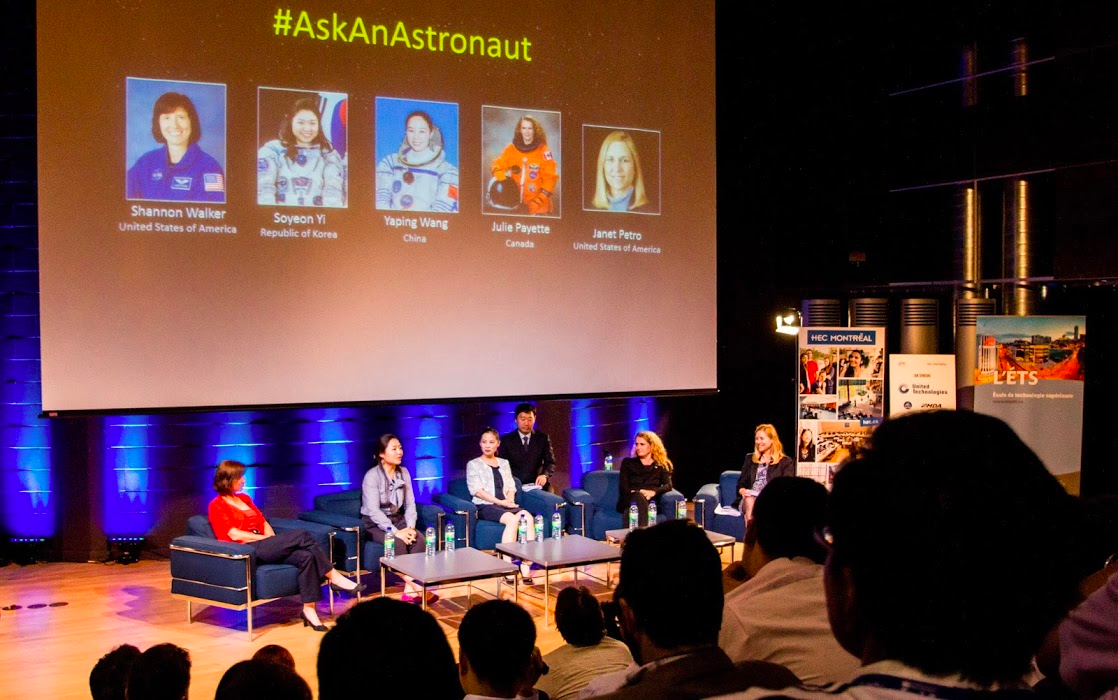
Soyeon-Yi took part in the annual Space Studies Program astronaut panel the night before. This was the first year that the panel was all-female! One small step for women and one giant step for gender equality :)

The last week of Departmental Activities included a visit to the Canadian Space Agency (CSA) and the Montreal Biodome.

We visited the headquarters of CSA and saw the Canadarm training facilities as well as observing mission deployment using a Juno rover prototype in the outdoor Mars yard. The rover was controlled via remote tele-operation from the ExDOC control centre.

The penultimate Departmental Activity took us to the Biodome - the 'house of life' in the heart of the city. Its 5 enclosed ecosystems are a great way to learn about life support systems in space. Animals and plants from across the world are housed here including the adorable sloths and penguins (my favourites)!
The last Departmental Activity was Project Presentation Day. Participants in my Department had been working on a Human Performance in Space project for the past 2 weeks. With topics ranging from embryonic development in space to the influence of plants on humans in space, the talks were very insightful and I loved hearing such interesting presentations from everyone. Below is a presentation on a project that I proposed - Creative Communication of HPS. I was very impressed with the inspiring results of the research done by Ariane and Akane - the wonderful participants that chose my topic :)
Afterwards, we treated everyone to a surprise party complete with balloons, cake and snacks! Always a great combination. As a thank you for my work as their TA, the participants got me a cute teddy and flowers :) I miss my HPS-ers already!
 
Following the end of Department time, Alumni Weekend was upon us here at SSP14. Every summer, International Space University alumni from across the globe attend this weekend wherever that year's summer program is taking place. Below is a photo of alumni from the year that I did SSP in Florida - SSP12  :)

The annual Space Masquerade Ball and Alumni Vs Participant football match also takes place during Alumni weekend. There's a costume competition and this year's prize went to a group that collectively dressed up as the International Space Station! Cultural night was also incredible this weekend since it was Canada's turn - they put on a great show!

Right now we're in the middle of Team Project work. It's pretty hectic with report writing, editing and deadlines but the end of SSP will be upon us next week as Week 9 arrives and we will start to fly back to our respective corners of the world. SSP has once again ended too soon -my next blog post will include some of the highlights of SSP14 so that I can relive the program through memories of the summer.

-Nikita

*Photo Credits: Hugo Wagner


Wednesday, 9 April 2014

From Rocket to Space Hotel

Utilizing existing technology and sustainably housing humans in space is a seemingly futuristic concept that already has its wheels in motion today. Space company Tasha9503 is designing hotels to put into low Earth orbit (LEO) using used rocketry and the available technology of today.
Orbital colonization as the next step for humanity was discussed in the recent Space Safety article, Living in Space. Exploration is in our nature and settling amongst the stars inside orbital habitats is a method through which this can be achieved.
Constant human presence in space has already been established through the International Space Station (ISS) — which has housed humans continually ever since its first crew in 2000. This powerhouse of scientific
An artist's impression of Tasha9503's space hotel (Credits: Tasha9503).
An artist’s impression of Tasha9503′s space hotel (Credits: Tasha9503).
research is the product of international cooperation between 15 nations and is a powerful testament to our potential in space. By unlocking this potential capability to work together both on and off of our home planet has been demonstrated — and in turn gives rise to a plethora of new orbital habitat concepts that may one day become a reality.
In order to live in space sustainably, cost needs to be low and reusability must be a key component.  This will allow maximum utility to be gained from the grand endeavour. One such concept that focuses on reusing existing components is HotelsInSpace by Tasha9503  — which aims to put great numbers of people in space at a low cost. The company will build spaceships from specially designed used rockets, which are capable of lifting 6 satellite payloads and up to 200 paying customers.
This ambitious plan arose after the founder Trevor Cooper heard somebody mention that they would like a spaceship in which their children could mine smelt forge at the Asteroid Belt, manufacture living accommodations on site, whilst continuing to study the cosmos. And so, HotelsInSpace was born.
The International Space Station orbits majestically as the first permanent human outpost in space Credits: NASA).
In an attempt to open up space travel and space tourism to the general public, Tasha9503 is offering a destination in LEO for the cost of one million US dollars per week. In 2005, they drew up a redesign of the ‘Saturn V’ rocket so that upon arrival in LEO, it could be easily reconfigured and attached to five other redesigned rockets, forming a 72 until hotel. The company has estimated that 500, 000 people investing $25 per week are required in order to have the first hotel in space within seven years. Once in orbit, this hotel in space will be open for business to rent as holiday resorts.
The vision of Tasha9503 extends past sustainable living in Earth orbit. Additional hotels will be built, which cannot land but are capable of taking people on away missions to any orbit within our solar system.
With destinations such as the Asteroid Belt, Earth’s Moon, Mars, Saturn, Jupiter, and Venus in mind — Tasha9503 dreams big and intends to use the magic of engineering to bring these to life.
Another secondary goal is to help to clean up the existing space junk. Activities in space currently add to the space debris issue that our planet is facing. Littered above our heads are the remnants of the past 60 years of human space activities. A wonderful achievement, yet it comes with a responsibility to protect our planet. Comprised of defunct satellites and spent rocket stages — explosion and fragmentation of this debris further exacerbates the problem.
Tasha9503 plan to use their hotels to collect space junk. Each spaceship will include 6 robotic arms in order to collect orbiting debris. The cost of this great number of robotic arms will be covered through renting out the
The Earth is surrounded by a halo of space debris (Credits: ESA).
72 units within each spaceship, as well as private funding.
Trevor Cooper commented on the concept:
“Wrapped around the spaceship are magnetic tracks that these arms can travel along or spin at a safe speed. Depending on the speed and direction of the SpaceJunk, the arm holding the rocket engine will spin around the spaceship so as the SpaceJunk approaches; it will end within the rocket engine. Then the robotic arm slows the spin and passes the rocket engine in through a large day door.”
The Stanford Torus, one of the several orbital habitat designs proposed by Gerard O'Neill (Credits: Rick Guidice/NASA Ames Research Center).
The Stanford Torus, one of the several orbital habitat designs proposed by Gerard O’Neill (Credits: Rick Guidice/NASA Ames Research Center).
Old satellites can also be collected and refurbished, rebuilt, repositioned or scrapped by this technology. Space debris may also be used as shields when in proximity to the Asteroid Belt. Trevor explains, “Because most of the SpaceJunk is moving in the same direction, but dozens of miles apart we will only be able to capture what we get close to — unlike the ISS which is moved away from SpaceJunk for safety.”
The concept of living in space sustainably is not a new one and Tasha9503 is certainly not the only player in this space arena. Space habitats in LEO have been conjectured for years. In the 1970s, Princeton physicist Gerard O’Neill demonstrated that orbital space colonies were physically possible, attractive places to live, and may make economic sense. Now, private companies and nations are developing methods by which this can be achieved. Companies such as SpaceX are building cheaper rockets, and have sustainability at the forefront of their design process.
Bigelow Aerospace's first operational spacecraft Genesis I was a tremendous success (Credits: Bigelow Aerospace).
Bigelow Aerospace’s first operational spacecraft Genesis I was a tremendous success (Credits: Bigelow Aerospace).
Bigelow Aerospace plans to greatly increase the usable space of the ISS at a fraction of the cost. Established in 1999, Bigelow spacecraft utilizes expandable or ‘inflatable’ structures and space systems. By redesigning initial NASA inflatable space habitat designs, the company launched the world’s first expandable space habitat prototypes with the Genesis program’s Genesis I in 2006. Tasha9503 hopes to one day wrap the outer surface of each hotel with a layer of Bigelow’s inflatable structures. Such cooperation is essential in order to achieve greatness as a species, as demonstrated brilliantly by the ISS.
Orbital colonization is a stepping stone to Mars and eventually interstellar spaceflight. Building an oasis in space may help to save our species in case of a catastrophic disaster on Earth, or will be a way to gain orbital perspective on vacation from our busy lives on Earth. Either way, it is a demonstration of our human intelligence and capability. The research that we conduct today will form the foundation of Earth’s home away from home of tomorrow.
Written for Space Safety Magazine by Nikita Marwaha.

Thursday, 27 February 2014

What’s On the Space Menu? – Vegetables Grown in Space Deemed Safe to Eat


The History of Space Food


The long quest for adequate nutrition in space has taken astronaut consumption from toothpaste tubes and gelatin coated cubes to freeze-dried foods and now to the possibility of freshly-grown vegetables.
This ever-evolving space menu was well documented in Space Safety Magazine’s Space Food special earlier this year, covering the past, present, and future of space food — the struggles to achieve food that is nutritious, long-lasting and safe in the space environment has been a long one.
Early space food involved pre-packaged items that although technically safe and nutritious, were not as appetizing as fresh foods. (Credits: NASA)
Early space food involved pre-packaged items that although technically safe and nutritious, were not as appetizing as fresh foods.
(Credits: NASA)
The first space food used on missions consisted of vicious fluid packaged in aluminium tubes, similar to toothpaste tubes. The first man in space, Yuri Gagarin, tested the functionality of the digestive system in space with chocolate sauce and meat paste packaged in such tubes. Although effective for use in microgravity, these were deeply unpopular. Gelatin coated cubes and rehydratable freeze dried foods also made appearances early in the US space program. Available in flavors ranged from cereal to bacon and strawberry — these were not continued since they generated crumbs that posed an inhalation hazard in microgravity and also formed a sticky coating. On the other hand, the rehydratable freeze dried foods that followed were deemed unappetizing by astronauts. The experience and technology gained from these previous iterations of space food helped researchers hone these dense nutritional packages into items of recognizable, even appealing items on the space menu of today.

Achieving Edible Fresh Food in Space


The journey is far from over and the production of fresh food in space without resupply missions from Earth is the ultimate goal. However, we are now half-way there, as growing fresh food in space that is edible has now been successfully achieved. As RIA Novosti reports,Russian scientists have recently verified that several plants grown in space are safe for human consumption. The space grown vegetables range from peas and Japanese leafy greens to dwarf wheat — all of which passed tests on Earth for abnormalities or harmful microbes.
Margarita Levinskikh of the Institute of Biological Problems told the radio show The Voice of Russia that “The plants have been very developed, absolutely normal and did not differ a lot from the plants grown on Earth.” As a co-investigator on the NASA study to validate the Vegetable Production Unit (VPU), she works alongside scientists to ensure that the procedures and protocols used aboard the International Space Station (ISS) to grow fresh food maximise astronaut health and well-being.
The importance of not only growing but also testing the food grown by astronauts and cosmonauts is vital to our development as a space faring species. To assume such foods to be safe once grown in space is a dangerous risk to take. With plant growth affected by the microgravity environment in ways that we do not yet fully understand and microbial organisms known to develop into more virulent varieties under microgravity conditions, scientific investigation of food grown in space is mandatory during this developmental phase of consuming fresh food in space.
The Lada greenhouse, named after the Russian goddess of spring houses vegetables grown aboard the International Space Station. (Credits: NASA)
The Lada greenhouse, named after the Russian goddess of spring houses vegetables grown aboard the International Space Station.
(Credits: NASA)
Currently, vegetables are grown on board the International Space Station in a special greenhouse named Lada, after the Russian goddess of spring. The unit is equipped with removable root modules containing enough nutrients for several generations of crop-growth — astronauts send these modules back to Earth for analysis once the nutrients are used up. Biologists then probe the root modules and the plants’ leaves for contaminants which may originate from the space station’s environment.
“We have also gotten experience with the astronauts and cosmonauts eating the fresh food they grow and not having problems,” said crop scientist Bruce Bugbee who is also a co-investigator in the research, in an email to Popular Science. As a professor at Utah State University, Bugbee has worked on numerous studies of food grown in space. He adds in an email to Space Safety Magazine, “Since the earliest days of the long-term manned space program, space grown food has undergone an enormous amount of testing… to-date, we have been able to grow only small amounts of fresh food in space. We have long known that fresh food in the diet is important to health.  Dieticians have pushed for more fresh food in the diet in space.  Health professionals are concerned about the safety of a long-term diet of dried, stored food.  We have been working to be able to gradually change this diet.”
With human spaceflight missions sent to increase in duration as we venture further into the cosmos, growing edible food in space is an important area of research for future human settlements in space.  There are several research programs underway that investigate the growth of plants in space. Hundreds of seeds have flown in orbit to determine the effects of the environment – particularly radiation – on their ability to germinate. The use of plants as part of a self-sustaining habitat is another popular area of research that will bring humans one step closer to living in a closed life support system in space. A NASA research team has already developed 100 menu items for use in the Martian environment as humans eventually venture beyond low Earth orbit and journey to the Red Planet to stay.

Orbital Comfort Food


Home comforts whilst abroad on Earth can be an uplifting experience – even more so when orbiting above Earth or on another planet. Such space treats are a welcome break from the monotony of the safe-to-eat space menu and items including Coke, bread, and alcohol have all been briefly embraced by NASA in the past.
Astronauts have access to a variety of flavored drinks whilst in space however soda and carbonated beverages pose a hazard inside their pressurized vessels if carbon dioxide bubbles escape to form a foam or stay in to affect astronaut’s stomachs. However, in 1985 Coca-Cola, and to some extent Pepsi tried to solve these problems by designing special space cans with controlled dispensing. Unfortunately, they were unable to make drinkable coke and carbonated space beverages were not continued and are not available on the ISS today. However, the Coca-Cola cans designed for space did make a special appearance as part of the opening ceremony of the 22nd Winter Olympic Games in Sochi, Russia. The minute-long advertisement shows a U.S astronaut and a Russian cosmonaut aboard the orbiting outpost watching their two nations going head-to-to head in an Olympic hockey match on Earth. The rivalry between the two jersey-clad crewmates soon gives way to camaraderie as the soft drink is spills and floats around the station, resulting in a team effort to catch the bubbles.
An astronaut drinks Coca Cola from a specially designed can which was flown on the shuttle, yet the carbonated space beverage produced unwanted stomach effects in microgravity. Credits: (NASA)
Bread is a food staple on Earth, however, when taken to space in the past it quickly molded due to the high oxygen environment. One of the most famous space food stories is that of John Young sneaking a corned beef sandwich aboard Gemini 3. The stowaway sandwich quickly turned dry and crumbly and today, ISS crews prefer to use tortillas as a bread alternative due to their long shelf life and low crumb production.
The notion of extraterrestrial sherry arose during the early seventies, when NASA’s focus was shifting from short, Moon-focused missions to missions requiring long-term inhabitation of space; sherry was considered as an addition to the Skylab menu. A small quantity of Paul Mason California Rare Cream Sherry was ordered for the entire Skylab mission and tested on NASA’s zero G plane. Unfortunately, adverse odors and reactions were noted and the sherry never went to space. It was not deemed necessary for nourishment or as part of balanced diet, unlike vegetables which are very much considered a necessity to living in space for the long run. (Gizmodo)
On the other hand, the Russians have looser standards than NASA when it comes to drinking alcohol in orbit. Alexander Lazutkin, who lived aboard Russia’s Mir space station commented that Russian doctors have been said to have sent alcoholic beverages along with spacefliers for years to keep them “in tone” and to “neutralize tension. ” At the beginning of the Space Age, cognac was recommended to stimulate cosmonaut’s immune systems. With strenuous space walks and a stressful working environment, the Russians believe that alcohol helps to enhance job performance and reduce stress.

The Future of Orbital Farming

With the focus of space research moving away from luxury items such as coke, bread and sherry and onto fresh foods, it is important to highlight the advantages of space farming. As well as the nutritional benefit, growing food in space could eventually lower the cost of resupply missions to the International Space Station and have positive effects on the psychological health of astronauts through tending for the plants as they grow.
“Caring for a plant every day provides vital psychological relief, giving astronauts a small remembrance of Earth,” NASA scientist Howard Levine told Modern Farmer.
'Diary of a Space Zucchini', a poignant account of the life of a zucchini was kept by astronaut Don Pettit as it grew on board the International Space Station. (Credits: NASA)
‘Diary of a Space Zucchini’, a poignant account of the life of a zucchini was kept by astronaut Don Pettit as it grew on board the International Space Station.
(Credits: NASA)
An example of such positivity from growing vegetables in space is Astronaut Don Pettit. He kept ‘Diary of a Space Zucchini’ during his time aboard the station and wrote a creative and poignant personified account of the life of a zucchini growing in space.
“Excitement is in the air. Gardener said we will soon be returning to Earth. Our part of the mission is nearly complete and the new crew will take over for us. I am a bit worried about Broccoli, Sunflower, and me. If Gardener leaves, who will take care of us?” Pettit writes in the voice of the zucchini.
Following the recent verification from scientists that fresh food grown in Lada is deemed safe for consumption, the space menu is set to expand as other vegetable varieties join the line up to grow in the space greenhouse. After repairing Lada, researchers are planning to grow rice, tomatoes, and bell peppers aboard the International Space Station next year, none of which have ever been grown in space before.
With orbital farming in the process of becoming safer with each harvest, the space menu has come far from its toothpaste tube origins. Yet, there are still many questions to be answered and challenges to be tackled with growing food in space. The behaviour of vegetable growth in microgravity requires further long-term study as do types of vegetables that may be practical – and impractical – to grow in space. In time, research into orbital meat growth may one day arise as we establish long-term settlements in space and the natural human appetite for meat is catered to. The space menu is ever-changing and it is vital that time is spent now to produce the nourishing and tasty foods that will stock the space kitchen cupboards of the future.
Feature image caption: Astronauts currently enjoy fresh food sent up from Earth in resupply missions to the station. (Credits: NASA)
Written for Space Safety Magazine by Nikita Marwaha

Sunday, 23 February 2014

Columbus Calling

Yesterday morning, I was lucky enough to be given a tour of the Columbus Control Centre. Located at the German Aerospace Centre - DLR (Deutsches Zentrum für Luft- und Raumfahrt) it sits just outside Munich in a place called Oberpfaffenhofen (also, my new favourite German word).


 As the Mission Control Centre for the European Columbus module of the International Space Station (ISS), engineers here are in contact with the astronauts up in space as well as other ISS Mission Control Centres scattered across the globe. It was a pretty amazing way to start my weekend!


The Columbus module is the European part of the ISS. It is a European Space Agency (ESA) laboratory attached to the space station, where astronauts conduct experiments in fields ranging from plant biology, fluid physics, life science and material science. 

Launched into space nestled inside the Space Shuttle Atlantis in 2008the Columbus module is a powerhouse of  space research and it is here, at the Columbus Control Centre that the space laboratory is controlled.


This room in the photos above is the Flight Control Room. It's staffed by a minimum of 3 people around the clock who monitor the module to ensure that everything is functioning correctly. Each astronaut's schedule is mapped out down to 5 minute increments  with 8 hours of work, 8 hours of play and 8 hours of sleep all precisely pencilled into the computer program on the screen above. Since it was a weekend, the astronauts are given this time off, so are free to enjoy the wonders of zero gravity without disturbance.

It was a really great day and a fascinating behind-the-scenes insight into the enormous global effort that the space station is, both on Earth and in space. 
A friendly engineer even let us sit in his chair for a photo op :) The button I'm holding speed dials an astronaut via Houston!

-Nikita

Related Posts Plugin for WordPress, Blogger...