Monday, 7 October 2013

Detecting Heartbeats : NASA Technology Used to Rescue Disaster Victims on Earth


A revolutionary radar device that can detect the heartbeats and breathing patterns of disaster victims trapped under rubble has been developed by NASA in conjunction with the US Department of Homeland Security (DHS).
Aptly named Finding Individuals for Disaster and Emergency Response (FINDER), the radar technology has the ability to locate individuals buried as deep as 9 meters and from a distance of 30 meters, according to NASA.
The FINDER team unveiled the technology on September 25 at a demonstration for members of the media at the DHS Virginia Task Force 1 Training Facility in Lorton, Virginia.
Time is of the essence in the civilian response world, in which there is a limited time following a traumatic event when a victim’s odds of survival are highest. This time, called the Golden Hour, can range anywhere from minutes to a few hours. When finding the victims in need of rescue is its own challenge, FINDER can help.
“The ultimate goal of FINDER is to help emergency responders efficiently rescue victims of disasters,” said John Price, program manager for the First Responders Group in Homeland Security’s Science and Technology Directorate in Washington.
The device works by sending out a continuous, low powered microwave radar signal into the rubble, through which reflection patterns are analyzed and human life is detected.
FINDER utilizes the space technology used in remote sensing of the Earth and spacecraft detection in order to ensure that those trapped in rubble have the greatest chance of survival following a disaster.
“Detecting small motions from the victim’s heartbeat and breathing from a distance uses the same kind of signal processing as detecting the small changes in motion of spacecraft like Cassini as it orbits the Sun” said James Lux, task manager for FINDER at NASA’s Jet Propulsion Laboratory (JPL).
An outgrowth of NASA’s remote sensing technology, FINDER analyzes radar signals using advanced data processing algorithms developed by JPL. Within the chaotic, post-disaster environment this technology can distinguish the tiny signals from a person’s moving chest from the surrounding signals such as moving trees and animals nearby.
This technology has potential applications in NASA’s future human space flight missions, reducing the need for wires when monitoring astronauts’ vital signs.
Weighing less than 20 pounds, the device looks like a plastic briefcase and fits in the overhead compartment of aircraft.  Testing has been in progress for a year and its predicted commercial release is as soon as the spring of 2014.
Future developmental phases of FINDER will focus on a more specific locater function that can detect not only the existence of a victim but more precisely where in the rubble the person is located.
John Price, program manager from the DHS’ First Responders Group called FINDER “probably the greatest advance in the last 30 years.”
Watch video from the FINDER test, below:


Written for Space Safety Magazine by Nikita Marwaha

Sunday, 6 October 2013

Nikita's News


We're well and truly into Autumn here in the UK and the time I usually spend starting a new academic year has now been replaced by time spent planning my time in 2014! Turning 23 next week, I'm now back in London with a few ideas up my sleeve for what the year ahead may hold. One of these is the newly released daily, online newspaper that goes by the name of Nikita's News (I'm a sucker for alliteration). It has a nifty way of sourcing my favourite online posts via twitter into one beautiful place for you to read easily and conveniently, allowing me to select and edit daily content as I please. Covering sources from my favourite astronaut Cmdr Chris Hadfield, to the life-changing International Space University and my favourite writer & comedian Mindy Kaling, Nikita's News has a range of information for everybody to enjoy. Whether you want an update from the European Space Agency (ESA), the magazine I've just begun writing for Space Safety Magazine, inspirational businesswoman and role model Sheryl Sandberg or even from little old me via my twitter account Nikita_, then Nikita's News is the place to be!

Take a look for yourself at: http://paper.li/Nikita_/1380979535

Don't forget to hit that subscribe button :)

-Nikita

p.s I've been asked if I can really make apple pie from scratch. Find out soon whether I can invent the universe/my cooking skills and make Carl Sagan proud!

Wednesday, 4 September 2013

Graduation

Credit: David Gaston Sulitzer


My time as an International Space University (ISU) student has now drawn to a close! Last week, around 50 students from the MSc13 class returned from their internships across the globe to quaint old Strasbourg town. Located on the border to Germany, the French city has been my home for the year (see my blog post here). I've made lifelong friends, memories and learnt more about who and what I want to be in the years to come. 

I began as an ISU Space Studies Program (SSP) student back in the summer of 2012. You might remember it from my 'This one time at space camp' blog post found here. The program is held in a different place every year and I was fortunate to attend the 25th (and best!) one of all in Florida. Witnessing 2 rocket launches and Space Shuttles Endeavor and Atlantis made it an incredible taster of what ISU has to offer. And I was not dissapointed with the Masters program. From trips to Russia, Toulouse, Switzerland, Germany and finally my internship in San Francisco at NASA Ames Research Center this summer, I've had the time of my life. After presenting my project 'The New Media Innovation Team at NASA Ames Research Center' to faculty, I graduated the following week with a Masters in Space Studies! I  am now one of the 3500 ISU alumni scattered across the planet.


I hope you've enjoyed following my ISU journey as much as I have loved writing and sharing it with you. I will no doubt continue with space and science posts and definitely, more space adventures to come! 

-Nikita

p.s If you have an interest in space and would like to learn about how you can make a difference to help humanity become a spacefaring species, then I'd recommend ISU for you, regardless of your academic background. Find out more on the programs ISU has to offer here and I promise, you'll join a space family like no other. 

Sunday, 18 August 2013

Fly Me To The Moon

Going to the Moon is so 1960s I hear you say? Not anymore my friend. Space company Moon Express plan to not only go to the Moon, but mine it whilst they are there. Founded by my university's co-founder Bob Richards of the International Space University (ISU) with entrepreneurs Naveen Jain and Barney Pell, the privately-funded lunar resource company is headquartered in the NASA Ames Research Park, California. It is there, that they are using a unique blend of  the agile Silicon Valley start-up approach with aerospace engineering and planetary sciences expertise to put their plans into action.

Resources of economic value such as Yttrium, Dysprosium, Nyobium that are rare on Earth are what the rovers built by the Moon Express team will look for and extract. By providing people with such resources, they are focused on opening up the resources of the Moon for the benefit of humanity. 

With this long-term goal in mind, developing and eventually offering commercial lunar robotic transportation and data services is what the company is also working on. Most recently, MoonEx (as they are also known) announced their collaboration with the International Lunar Observatory Association (ILOA) in order to conduct the world's first mission to the Moon's South Pole. Using the Moon Express robotic lander, an International Lunar Observatory (ILA) will be delivered to the Moon's surface. There, it will be the first instrument ever to photograph and listen to the Universe from the Lunar perspective. Finally! The Moon will be lonely no more (sorry Moon).


As well as all of the incredible above plans, MoonEx are striving towards winning the Google Lunar X PRIZE, an international lunar competition with the incentive of a $20M first prize. It really is a race to the Moon. Again.


Last week, Bob hosted my ISU friends and I with lunch at MoonEx HQ where he shared fond stories of the past and inspirational dreams of the future of ISU. We then began a tradition of visiting a tree planted at NASA Ames in memory of Todd B. Hawley, ISU co-founder and space visionary. I do hope that future ISU interns at NASA Ames continue this tradition in the many years to come.

"Together we shall aspire to the stars with wisdom, vision and effort". - From the ISU Credo

-Nikita 


Saturday, 10 August 2013

The SETI Institute & Google


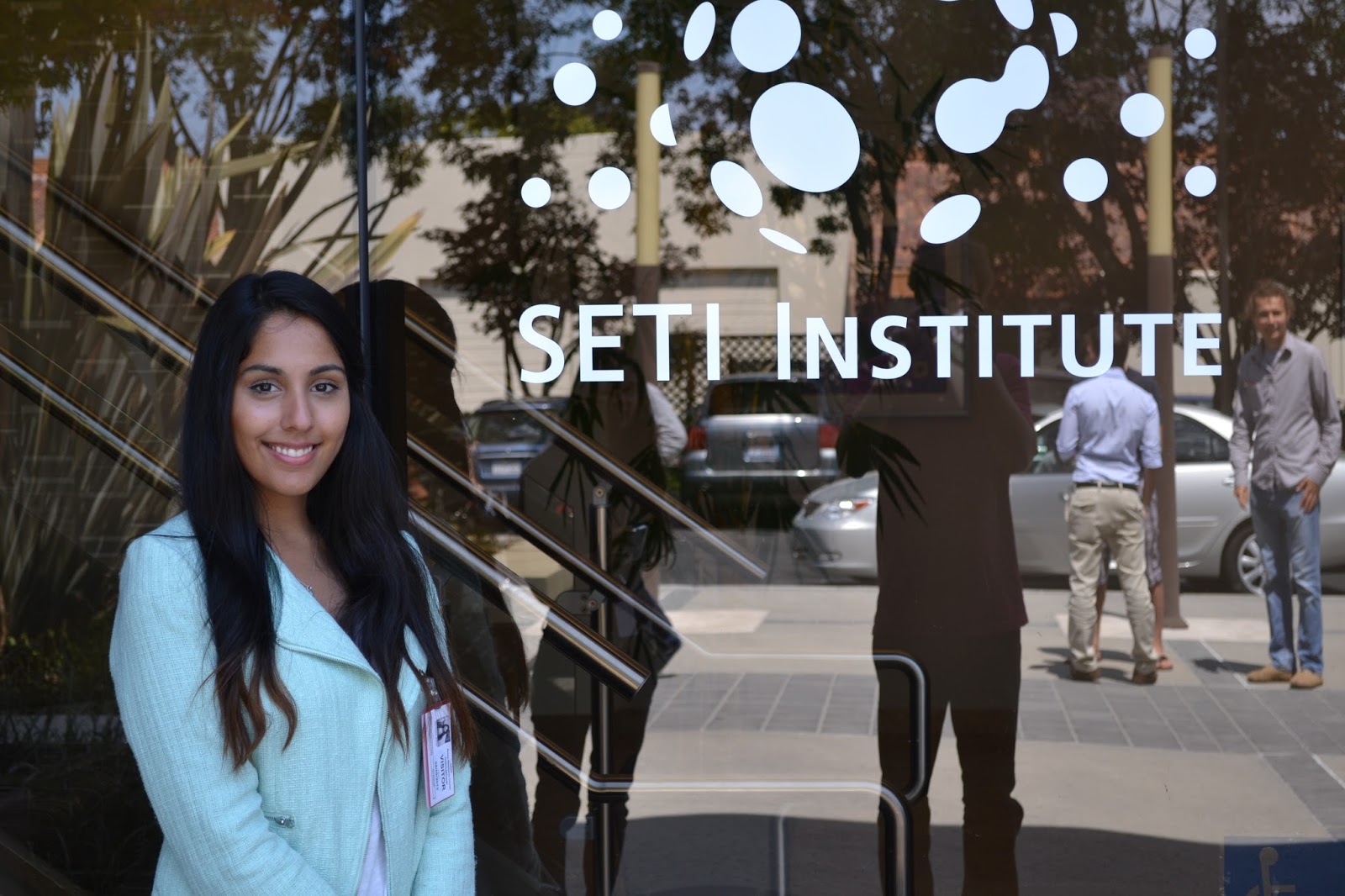
If any of you have seen the film Contact then get ready to meet the real-life Ellie Arroway. I was invited to the Search for extraterrestrial intelligence Institute, otherwise known as the SETI Institute this week. Founded by Frank Drake, the equation guy, they host regular lunchtime talks on various space themed topics. I attended the one titled "New tricks to find and study habitable exoplanets" Scientifically obtaining images of rocky planets in the habitable zone is key to detecting whether life exists outside of our solar system and how it does so. If you're wondering, the habitable zone is the zone within which conditions for life are just right, usually not too close and not too far from the star it orbits. Planets found within the habitable zone are sometimes called 'Goldilocks' planets, after the porridge from the fairy tale that is also not too hot and not too cold but, 'just right'. Yes, science is cute as well as fascinating :)

After the talk, my friends and I had a tour of the centre and were lucky enough to meet Dr. Jill Tarter. Astronomer and director of the SETI Insitute, she has spent 35 years of her life in the search for extraterrestrial life. Her work is illustrated in Dr. Carl Sagan's 1985 book 'Contact' which tells the story of Ellie Arroway, a radio astronomer also searching for extraterrestrial life. Played by Jodie Foster in the 1997 movie, Dr. Jill Tarter provided guidance to the actress during the making of the movie in order to ensure scientific accuracy. The real-life Ellie Arroway taught us about the Allen Telescope Array in Hat Creek Observatory, California that studies many areas of the sky at once,bringing us one step closer to detecting a signal from extraterrestrial technologies and discovering intelligent life off of this planet. The Earth flag, shown in the above photos is a suggestion of the flag that should be used when humans visit planets, moons and asteroids. As opposed to the American flag that is on the Moon today, the Earth flag illustrates our local neighbourhood (in space distances of course!). With the Earth, our Moon and our nearest star the Sun illustrated, the flag would make more sense to another spacefaring species. I think the flag will encourages people to think of themselves not as the nationalities of their country, but a collective group of of animals of the Homo sapiens species living on this rock that we call Earth. 

I returned to work after visiting SETI just in time for the end of the weekly Director's Colloquium talks that take place at NASA Ames Research Center.  This week, Google driverless cars were up for discussion and one was even parked outside the building! Obviously, I had to take advantage of the photo op with the futuristic technology. I can't wait for the day when they are the norm and road accidents due to human error is something of the past.

 What do you think? Are self-driving cars an obvious progression of our technologically advancing society or would you rather be behind the wheel? 

-Nikita

Wednesday, 7 August 2013

People Over Pixels


So I've once again been a complete tourist in the Silicon Valley. A friend of mine that knows someone that works at  Facebook  (something that is completely normal around here) invited me to join them for lunch at the social media giant's HQ. Upon arrival I was told to search our intern friend's name on Facebook using one of the many iPads in order to print my visitor's badge. I quickly learned that at Facebook, using Facebook is not only encouraged but is the primary method of office communication. Pretty much frowned upon in offices around the world,but around here if you're not on Facebook then you're not doing your job.

As you can see from the photos I was pretty amazed by the abundance of free (yes, free) food at Facebook. Food labelled with the infamous FB logo are free for employees to munch away on to their heart and belly's content. Writing on the walls is another non-traditional office activity at FB since what else would the walls of Facebook be for than to be written on?  This creative outlet has resulted in works of art that as you can see are beautiful and often inspiring. 

Of course, before leaving I had to sign the infamous 'Facebook Wall' and post it to my own Facebook wall in true inception-style tech-geekiness that can only be achieved in the Silicon Valley. I went for the generic 'Nikita was here 31/07/13, in true tourist fashion. With one week left in San Francisco,  these tourist posts are only going to increase as I attempt to cram as much sight-seeing in as possible!

 You have been warned :)

-Nikita

Monday, 5 August 2013

Rainbow Mansion & Space McDonald's


As our time in the Silicon Valley draws to a close, my friends and I have been making the most of what it has to offer outside of our work at NASA Ames Research Center.  First up, we visited the Rainbow Mansion. A communal house full of socially concious, international and driven people, the mansion hosted a lecture by Pascal Lee, co-founder and chairman of the Mars Institute and planetary scientist at the SETI Institute. His lecture on human settlement on Mars discussed colonisation of the red planet in a realistic and very much obvious second step for man and womankind. I mean duh..of course we're moving to Mars before we over-exploit Earth and poison our atmosphere right? Right. 

After dinner with entrepreneur Chris Kemp, CEO of cloud computing company Nebula (you may remember him from my '2013 So Far' post), we visited what can only be described as 'Space McDonalds'. It doesn't house the usual burgers and fries but instead, vintage space footage from NASA's Lunar Orbiter mission that was sent to the Moon prior to Neil Armstrong's mission in 1969. As part of the Lunar Orbiter Image Recovery Project (LOIRP), previously unopened audio and video footage from the 60s is restored and digitised under Ronald McDonald's roof. As you can see from my photos, the McDonalds hasn't changed much, with Apollo era footage stored and masquerading as Strawberry Jelly and Hotcake Syrup!

The Computer History Museum held a Byte Night event for Silicon Valley interns this week. The largest museum for the preservation of artefacts from the Information Age -  basically tech-nerd heaven. In the photos you can see my friends John, David and I trying and failing to compete against the artificially-intelligent computer system, Watson. I even spotted one of my childhood favourites, Playstation 1 on display! Now if that doesn't make me feel old I don't know what will.. :(

Space company Planet Labs gave us a quick tour of their San Francisco office within which they are designing, manufacturing and testing small satellites known as CubeSats. Set to launch 28 by the end of the year, the company are dedicated to monitoring the environment . This window into the ever-evolving, beautiful Blue Marble is useful for for applications such as precision agriculture and land-use monitoring, not to mention help society as a whole better understand the planet and cater to its needs.

My step stop on the Silicon Valley tour is a social networking company that I'm pretty sure most of you guys use everyday. Look out for my next post to find out what tech company I acted like a complete tourist at next!

-Nikita


Related Posts Plugin for WordPress, Blogger...